You already know what you should be doing.
Meditate. Exercise. Sleep more. Connect with people you love. Keep a gratitude journal. Spend time in nature. Put down your phone.
You know all of this. And yet, somehow, Sunday evening arrives and the week is gone — and not one of those things happened.
This is not a discipline problem. It is not laziness, and it is not that you don’t care about your wellbeing. It is something more fundamental: the structure of modern life is almost perfectly optimised to prevent the conditions that happiness research tells us actually produce lasting wellbeing.
The calendar fills itself. The urgent replaces the important. The notifications arrive before the intention can. And the happiness habits — the practices that research shows genuinely move the needle on life satisfaction, resilience, and meaning — end up relegated to a future self who has more time, more space, more energy than the present one ever seems to.
That future self never arrives.
So this is not a blog about what you should do when you have time. It is a blog about what the science says actually works when you don’t.
Before getting to solutions, it is worth understanding the problem precisely — because “I’m too busy” is not simply an excuse. It is a description of a genuine neurological state that makes habit formation measurably harder.
When the brain is under sustained cognitive load — managing multiple responsibilities, navigating complex information, making decisions repeatedly across a day — it depletes a resource that psychologists call executive function: the capacity for planning, self-regulation, and deliberate choice. This is the resource that willpower draws from. And like any limited resource, it runs out.
Decision fatigue research, pioneered by Roy Baumeister and replicated across dozens of studies, shows that the quality of people’s decisions deteriorates significantly across the day as executive resources are depleted. By evening, the brain’s ability to choose the harder, better option — going for a walk instead of watching television, journalling instead of scrolling — is substantially reduced.
This is why “I’ll do it tonight” is a promise made by a different brain than the one that tries to keep it.
There is also the issue of what psychologists call implementation intentions — or rather, their absence. Research by Peter Gollwitzer at New York University shows that the most reliable predictor of whether someone follows through on a health intention is not how motivated they are but whether they have specified when, where, and how they will do it. People who say “I will meditate” follow through roughly 35% of the time. People who say “I will meditate for ten minutes at 7:15 AM at the kitchen table before I make coffee” follow through roughly 91% of the time.
The difference is not motivation. It is specificity. And specificity requires planning — which busy people systematically deprioritise in favour of the immediate.
Understanding these mechanisms is the first step. The second is building a system that works with them rather than against them.
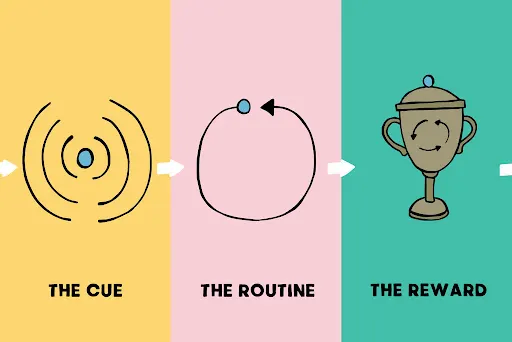
Happiness research on habit formation — synthesised across the work of BJ Fogg at Stanford, James Clear in behavioural psychology, and Wendy Wood at the University of Southern California — converges on a set of principles that are specifically relevant for time-constrained people.
Habits require a cue, a routine, and a reward. This is Charles Duhigg’s habit loop, but the research behind it is deeper than the popular version suggests. The cue is what triggers the habit. The routine is the behaviour itself. The reward is what trains the brain to repeat it. For busy people, the most practical implication is this: you cannot build a new habit reliably on motivation alone. You need to attach it to something that already happens — a reliable environmental cue that fires the behaviour automatically, without requiring a decision.
The size of the habit matters enormously. BJ Fogg’s Tiny Habits research demonstrates that the single biggest mistake people make when trying to build wellbeing habits is starting too large. The ambition of “I will meditate for 30 minutes every morning” creates an activation energy threshold that is too high for a depleted or time-pressured brain to consistently clear. “I will take three mindful breaths after I pour my first coffee” has almost no activation energy — and it can be done in under a minute while doing something you already do.
Consistency beats duration. The neuroscience of habit formation is about the strengthening of neural pathways through repetition. A two-minute daily practice performed consistently for two months does more to build a neural habit than a 30-minute practice performed irregularly. The brain does not distinguish by duration. It distinguishes by frequency.
Emotion consolidates memory and habit. Research on memory consolidation shows that experiences with positive emotional valence — things that feel good — are more readily encoded as habits by the hippocampus and basal ganglia. This means that how a habit feels when you do it matters enormously for whether it sticks. A joyless gratitude practice that feels like a chore is much less likely to become automatic than one that consistently produces even a brief moment of genuine warmth or recognition.
These practices are drawn directly from happiness research and specifically selected because they are effective at small doses, fit into existing routines, and do not require additional time slots in an already-full schedule.
The research on gratitude practice — particularly Martin Seligman’s seminal work on positive interventions, and subsequent studies by Robert Emmons and Michael McCullough — consistently shows that even brief, structured gratitude practice produces significant and lasting improvements in wellbeing.
The version that works for busy people is not a journalling ritual that requires a quiet morning and a nice notebook. It is this: at one predictable moment in your day — in the shower, during your commute, while waiting for your laptop to start — name three specific things from the last 24 hours that you are genuinely grateful for. Not vague generalities. Specific moments, specific people, specific small pleasures.
The specificity is the mechanism. The brain’s attentional system learns to notice positive experience at a more granular level, which gradually shifts the default attentional landscape away from the negativity bias. Two minutes. Same time every day. No notebook required.
The most common reason mindfulness training fails to stick for busy people is that they try to carve out dedicated meditation sessions — which requires a free time slot that busy schedules rarely provide reliably.
The alternative is what BJ Fogg calls habit stacking: attaching a micro-mindfulness practice to something you already do every day without exception.
The research on brief mindfulness interventions shows that even 60 to 90 seconds of deliberate present-moment attention — noticing your breath, noticing physical sensations, noticing the sounds around you without labelling them — activates the prefrontal cortex’s regulatory capacity and produces measurable reductions in stress hormones.
Pick three moments that happen every day: waking up, making tea or coffee, and sitting down at your desk. At each one, take five conscious breaths before doing anything else. That is roughly two minutes of mindfulness training across the day. Done consistently over eight weeks, the neurological effects are real, documented, and meaningful.
Research on psychological wellbeing consistently identifies meaning and purpose as among the strongest predictors of life satisfaction — stronger than income, achievement, or the frequency of positive emotions. Viktor Frankl’s logotherapy and Martin Seligman’s PERMA model both place meaning at the centre of lasting happiness.
The busy person’s version of this is not a morning journalling ritual or a vision board. It is one sentence, written or spoken at the beginning of each day: What would make today feel worthwhile?
Not what you need to get done. Not your priorities or your OKRs. What would make this specific day feel meaningful — regardless of what else happens.
The research on implementation intentions shows that naming an intention in concrete, specific terms significantly increases the probability of acting in alignment with it. One sentence, each morning, before the day takes over. It takes 45 seconds and changes the criterion by which the day is ultimately evaluated.
Of all the findings in happiness research, the relationship between social connection and wellbeing is among the most robust. Harvard’s 85-year Study of Adult Development — the longest longitudinal study of wellbeing ever conducted — found that the quality of close relationships is the single strongest predictor of life satisfaction, health, and longevity. Not wealth, not achievement, not intelligence. Relationships.
Yet social connection is almost always the first thing that gets sacrificed when schedules tighten.
The busy person’s intervention is not scheduling elaborate social events. It is investing in the quality of connections that already happen. One specific, genuine question per conversation: How are you actually doing? One text to someone you have been meaning to reach out to. One conversation where you are fully present rather than half-absent.
Oxytocin — the neurochemical of connection and trust — does not require a dinner party. It is released during brief, authentic human contact. The marginal moments are where human flourishing actually lives.
The research on exercise and mental health is extensive and compelling: regular aerobic exercise reduces symptoms of depression and anxiety comparably to antidepressant medication, without side effects, and with lasting benefits for brain structure and neuroplasticity.
But the version of this that busy people need is not the 45-minute gym session that never happens. It is the physiological state shift that five minutes of deliberate movement reliably produces.
Five minutes of brisk walking — outside, if possible — measurably elevates mood through endorphin and dopamine release, reduces cortisol, and improves cognitive function for up to two hours following. Research by Stanford’s psychology department found that even a brief walk increased creative output by 81% compared to sitting.
The habit is simple: whenever you transition between major tasks, move for five minutes before beginning the next one. It replaces the compulsive phone check that typically fills those transition moments — and it produces a measurably better neurological state for whatever comes next.
One of the more interesting findings in happiness research is the difference between experiencing positive events and savouring them. Research by Fred Bryant at Loyola University and Timothy Wilson at the University of Virginia shows that the duration of happiness derived from a positive experience is strongly influenced by whether the person pauses to consciously attend to it as it is happening.
The busy mind’s habit is to move immediately from one thing to the next — checking boxes, completing tasks, processing the queue. In doing so, it systematically underweights the positive experiences that do occur, because it never lingers long enough for them to register as genuinely good.
The practice: once a day, identify one moment that was good — however small — and spend thirty seconds consciously noticing it. Not reviewing it analytically. Actually returning to the sensory experience of it. The warmth, the specific quality of the pleasure, what made it good.
Thirty seconds. This is not a time problem. It is an attention problem — and it is solvable by attention.
This may be the most overlooked happiness habit in existence, and it requires less effort than any other item on this list.
The research on sleep and emotional wellbeing is unambiguous: sleep deprivation amplifies negative emotional reactivity, impairs emotional regulation, reduces positive affect, increases perceived stress, and degrades cognitive performance at every level. Matthew Walker’s neuroscience of sleep research shows that even one night of sleep below seven hours produces measurable deterioration in mood regulation the following day.
The happiness habit here is not “sleep more” — which is advice without a mechanism. It is this: establish a consistent sleep and wake time, seven days a week, and protect it with the same rigour you protect a client meeting.
The circadian rhythm regulates cortisol, serotonin, dopamine, and virtually every other neurochemical involved in emotional wellbeing. A consistent sleep anchor is not a lifestyle preference. It is the neurological foundation on which every other wellbeing practice depends.
Individual habits matter. But happiness research increasingly suggests that it is the system in which habits are embedded — the environment, the cues, the social context — that determines whether they endure.
Three principles of system design are particularly important for busy people:
Reduce friction to near zero. The harder a habit is to begin, the more executive function it requires, and the less likely it is to happen under cognitive load. Design your environment so that the habit’s starting point is already in front of you. Keep the journal on the desk, not in a drawer. Set the meditation app as your phone’s home screen. Put your running shoes where you will see them.
Connect habits to identity, not outcomes. James Clear’s research on habit formation shows that the most durable habits are those that feel like expressions of who the person is rather than means to an end. “I am someone who starts the day with intention” is more robust under pressure than “I am trying to be more mindful.” The behaviour follows from the identity rather than the motivation.
Make one change at a time. The impulse when reading an article like this one is to implement everything immediately. The research on habit formation is clear: attempting to build multiple new habits simultaneously dramatically reduces the success rate of each individual one. Pick one practice from this list. Build it to automatic — roughly 66 days of consistent repetition, according to Phillipa Lally’s research at University College London. Then add the next.

There is one more thing worth saying, and it requires a degree of honesty that productivity culture rarely allows.
Much of what we call busyness is not actually unavoidable. Some of it is. But a significant portion is a choice — or, more precisely, a failure to choose. A filling of time that feels less threatening than the space that would exist without it. A way of being that feels productive even when it is not, and that defers the more uncomfortable questions that stillness tends to raise.
Happiness research by researchers including Tim Kasser and Sonja Lyubomirsky finds that people who pursue extrinsic goals — achievement, status, wealth — at the expense of intrinsic ones — connection, meaning, growth — consistently report lower wellbeing regardless of how much they achieve. The busyness that is devoted entirely to external accomplishment, without investment in the inner life, tends to produce not fulfilment but a mounting sense of something missed.
The habits described in this article are not productivity hacks. They are a reorientation of what a day is for. They are a claim, made in small repeated acts, that the quality of your own inner life matters — not when things slow down, not when circumstances improve, but now.
You are not too busy to be happy.
You have been structuring time as though you are.
That is a structural problem with a structural solution. And it begins, as most things do, with one small act, done once, done consistently, until it becomes simply what you do.
Research by Phillipa Lally and her colleagues at University College London found that the average time for a new behaviour to become automatic is 66 days — not the commonly cited 21 days. However, the range in their study was 18 to 254 days, with simpler behaviours in more stable contexts becoming habitual faster. For busy people, the key finding is that missing one day does not significantly disrupt habit formation, but missing multiple consecutive days does. The most important variable is not perfection but consistency — and the most reliable route to consistency is starting with a habit small enough that missing it would feel slightly strange, rather than one ambitious enough that missing it feels inevitable. The Rekhi Foundation's happiness program teaches this principle directly: begin with the smallest possible meaningful version of the practice, and build from there.
The happiness research evidence consistently points to gratitude practice as producing the highest wellbeing return for the time invested. Martin Seligman's randomised controlled trials showed that writing three specific good things daily for just two weeks produced significant, lasting improvements in wellbeing and reductions in depressive symptoms — effects that persisted months after the practice ended. The key word is specific: vague gratitude produces weaker effects than detailed, sensory recollection of positive experience. This practice requires no equipment, no dedicated space, and can be done in two minutes at any consistent moment in the day. For people with genuinely limited time, this is the evidence-based starting point.
The primary reason is executive function depletion — the neurological phenomenon whereby sustained cognitive load across the day exhausts the brain's capacity for self-regulation and deliberate choice. Decision fatigue research by Roy Baumeister shows that willpower draws from the same cognitive resource that all deliberate decision-making uses — and that resource is finite. By the time most busy people reach the moment when they intended to practise mindfulness training or exercise, the self-regulatory capacity that would make the choice to do so has been substantially depleted by hundreds of smaller decisions throughout the day. This is why the solution is not more motivation but better systems: reducing the decision required, attaching practices to existing cues, and placing habits earlier in the day when executive resources are freshest.
Yes — and the evidence is specific. Research published in journals including Mindfulness, Frontiers in Psychology, and Psychological Science shows that brief daily mindfulness training — as short as five to ten minutes — produces measurable reductions in cortisol, improvements in sustained attention, and decreases in self-reported stress and anxiety when practised consistently. The key moderating variable is consistency rather than duration. What the brain is building through mindfulness practice is a neural circuit — the prefrontal attention network — and like any circuit it strengthens through repeated activation rather than occasional extended sessions. The Science of Happiness Course taught by the Rekhi Foundation is built on exactly this finding: small, consistent practices produce more durable neurological change than infrequent extended ones.
The relationship between wellbeing and performance is one of the most thoroughly documented findings in organisational and positive psychology. Research by Sonja Lyubomirsky and colleagues, and by Shawn Achor at Harvard, shows that positive affect consistently predicts higher creativity, better decision-making, stronger social relationships at work, lower absenteeism, and significantly higher productivity — effects that hold across industries, cultures, and job types. The causal direction in much of this research runs from wellbeing to performance, not the other way around. This directly challenges the implicit assumption of most productivity culture — that performance leads to happiness — and supports the happiness program approach of investing in emotional wellbeing not as a reward for achieving enough but as the foundation from which achievement becomes possible. Dr. Rekhi Singh's core assertion — "Happy people are more successful than the other way around" — is not a motivational claim. It is an evidence-based description of what the research consistently shows.

Rekhi Foundation, founded in 2016, promotes Happiness Science via university centers, collaborating globally across six countries.
Table of Contents
6/79, S/F, Gurudwara Road, Karol Bagh, New Delhi – 110005, INDIA
2051, Last Chance Court, Gold River, CA 95670, USA