There is a moment — you probably know it — when something shifts.
Maybe it is the second sip of your morning tea when the house is still quiet. Maybe it is the specific laughter of someone you love. Maybe it is finishing something hard, or standing somewhere beautiful, or the precise instant when a piece of music does what music does.
For a fraction of a second, everything feels exactly right.
What you feel in that moment is real. It has a physical address inside your skull. It involves specific chemicals, specific circuits, specific structures that neuroscientists have spent decades mapping. Happiness is not a mood, not a metaphor, not a philosophical abstraction.
It is biology.
And once you understand the biology, something important happens: you stop treating happiness as something that either arrives or doesn’t, and you start treating it as something you can work with.
For most of human history, happiness was considered the domain of philosophy and religion — a question of virtue, of fate, of divine favour. Neuroscience had nothing to say about it because neuroscience barely existed.
That changed in the late twentieth century when researchers gained the tools to look inside a living, feeling brain — functional MRI, PET scans, electroencephalography — and ask a question that sounds almost too simple: what is actually happening in there when someone feels good?
The answers have been accumulating for thirty years. They are more complicated than the popular version — the one that reduces happiness to a dopamine hit — and they are more interesting. Because what happiness research has revealed is not a single system or a single chemical, but an intricate, adaptive, and surprisingly trainable architecture.
Your brain was not built to make you happy. It was built to keep you alive. Understanding the difference between those two things is where the real insight begins.
Before we get to the neurochemistry of joy, we need to reckon with an uncomfortable fact.
Your brain has a fundamental design flaw — or rather, a design feature that was useful on the savannah and is catastrophic in a university exam hall or an open-plan office.
It is called the negativity bias.
The human brain processes negative information more deeply, more quickly, and more durably than positive information. A threatening stimulus activates the amygdala — the brain’s alarm system — in milliseconds. A positive stimulus registers more slowly and fades faster. Research by neuropsychologist Rick Hanson captures this with a phrase that has become famous in happiness research: the brain is like Velcro for negative experiences and Teflon for positive ones.
This made evolutionary sense. The ancestors who paid close attention to threats survived. The ones who lingered over pleasant sunsets got eaten.
But you are not being chased by anything. You are navigating a social world, a professional world, an academic world — where the negativity bias fires constantly and inappropriately. Where a single critical comment in a meeting can override ten positive ones. Where one bad grade can consume more mental bandwidth than five good ones.
This is not weakness. It is not pessimism. It is neurobiology doing exactly what it evolved to do, in a context it was never designed for.
The good news — and there is significant good news — is that this bias is not fixed. The brain is plastic. It can be reshaped. That is the entire premise of modern wellbeing science, and it is why structured practices like mindfulness training and gratitude practice are not soft skills. They are, quite literally, neurological interventions.
But first: what does the happy brain actually look like?
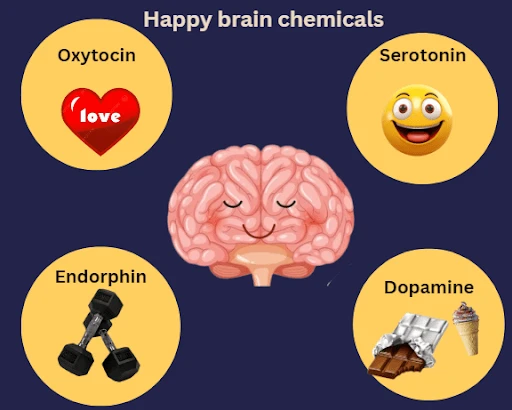
Popular culture has reduced the neuroscience of happiness to one word: dopamine. Dopamine is the happiness chemical. Dopamine is what social media is hacking. Get more dopamine, be happier.
This is wrong. Or rather, it is so incomplete as to be misleading.
There are four primary neurochemicals involved in what we experience as happiness and wellbeing. Each does something different. Each can be cultivated differently. And conflating them produces exactly the kind of confusion that leads people to chase the wrong things.
Dopamine is not the pleasure chemical. It is the anticipation and reward-seeking chemical.
Dopamine floods your system not when you get what you want, but when you expect you might. It is the neurological engine of motivation, pursuit, and desire. The hit of dopamine you get scrolling through social media is not from the content — it is from the possibility of interesting content. The next post might be fascinating. The anticipation keeps you scrolling.
This distinction matters enormously. It explains why achieving goals often feels less satisfying than pursuing them. It explains why winning can feel empty. And it explains why people who spend their lives chasing pleasure — more money, more status, more stimulation — often report lower wellbeing than those who invest in meaning and connection.
Dopamine is a poor master. It promises satisfaction and delivers the next craving.
Used well — in service of meaningful goals, genuine curiosity, creative work — dopamine is one of the most powerful forces in human psychology. Used badly, it is the architecture of addiction, anxiety, and perpetual dissatisfaction.
Serotonin is associated with status, belonging, and a sense of mattering — the feeling that you are valued, that you have a place, that your presence makes a difference.
Low serotonin is strongly correlated with depression. This is why the most common antidepressants — SSRIs — work by increasing serotonin availability in the brain. But serotonin is not simply an absence-of-depression molecule. At healthy levels, it produces a quiet, stable sense of confidence and social ease. It is the neurochemical of security rather than excitement.
What raises serotonin naturally? Recognition. Contribution. The experience of being respected. Reflecting on past accomplishments. Sunlight. Exercise. And — particularly relevant to happiness research — acts of generosity. Giving to others raises serotonin in both the giver and the recipient. This is the neurochemical explanation for why service and meaning are so consistently associated with wellbeing.
Oxytocin is often called the bonding or love hormone, which undersells it.
Oxytocin is released during physical touch — a handshake, a hug, proximity to someone we trust. It is the neurochemical foundation of social connection, the thing that makes humans feel safe with each other. It suppresses cortisol, reduces fear, and increases trust. It is why being with people we love makes stress feel more manageable.
And this is where happiness research becomes urgently relevant to the modern moment, because oxytocin requires physical presence and genuine connection to do its work. A text message does not trigger oxytocin. A like on Instagram does not trigger oxytocin. Video calls produce some effect, but nothing approaching the neurochemical richness of being bodily present with someone who matters to you.
The loneliness epidemic — disproportionately affecting young people, students, and urban professionals — is in large part an oxytocin deficit. We have built a world of constant digital communication and chronic physical disconnection, and our nervous systems are paying the price.
Human flourishing, in the neurochemical sense, is irreducibly social. You cannot think your way to the benefits of oxytocin. You have to actually be with people.
Endorphins are the brain’s internal painkiller system — released during exercise, laughter, and physical exertion. They evolved to allow injured animals to keep running, but in modern humans they produce the well-known runner’s high and the less-discussed laughter high.
The emotional wellbeing implications are significant. Exercise is not merely good for physical health. It is one of the most powerful interventions available for depression and anxiety — comparable in effect size to antidepressant medication, with no side effects and lasting benefits for brain structure.
Studies show that 30 minutes of aerobic exercise three times a week reduces depressive symptoms by up to 30%. Not because exercise is fun (it often isn’t) but because it floods the brain with endorphins, reduces cortisol, increases BDNF (brain-derived neurotrophic factor — essentially fertiliser for new neural connections), and promotes neurogenesis in the hippocampus, the brain’s memory and emotional regulation centre.
If there is a single most underrated happiness program available to every human on the planet, it is consistent physical movement.
Beyond neurochemistry, the structural neuroscience of happiness points to one region above all others: the prefrontal cortex — the large, uniquely human section of the brain directly behind your forehead.
The prefrontal cortex is responsible for planning, decision-making, emotional regulation, and the construction of meaning. It is, in a very real sense, the seat of your capacity for wellbeing. And it has an adversarial relationship with the amygdala — the alarm centre that triggers fear and stress responses.
When the amygdala fires, it can suppress prefrontal cortex function. This is why acute stress makes you think poorly, react impulsively, and lose access to your own better judgement. It is also why chronic stress — the kind that characterises modern student and professional life — gradually degrades the quality of cognition and emotional regulation over time.
Here is what the neuroscience of mindfulness training has revealed about this relationship: consistent meditation practice measurably strengthens the prefrontal cortex and weakens the reactive dominance of the amygdala.
Neuroscientist Richard Davidson at the University of Wisconsin spent decades scanning the brains of meditators — from beginners to Tibetan monks with tens of thousands of hours of practice. What he found was extraordinary: experienced meditators showed dramatically higher activity in the left prefrontal cortex (associated with positive affect and equanimity) and dramatically lower amygdala reactivity to stressors.
The monks he studied were not suppressing emotion. They were not spiritually bypassing difficulty. They were simply less automatically reactive to it — and more quickly recovered when it did arise.
This is what mindfulness for students and professionals is actually training: the capacity of the prefrontal cortex to stay online under pressure. The ability to respond rather than react. And this capacity is not a personality trait. It is a trainable skill with measurable neurological correlates.

There is one more piece of neuroscience that belongs in any honest account of happiness, and it is less well known.
In 2010, psychologists Matthew Killingsworth and Daniel Gilbert published a study using a smartphone app to ask thousands of people what they were doing, whether their mind was wandering, and how happy they felt — at random moments throughout the day.
Their finding was striking: people were happiest when their minds were focused on what they were doing, regardless of what the activity was. And they were least happy when their minds were wandering — even if they were wandering to pleasant things.
This relates to a brain network called the Default Mode Network — the system that activates when you are not focused on a task. It is the network of self-referential thought, rumination, worry, and mind-wandering. It is what your brain does when you are not doing anything else.
The Default Mode Network is not inherently harmful. It is involved in creativity, planning, and social cognition. But when it runs unchecked — when the mind spends the majority of its time in self-referential, often negative rumination — it is one of the strongest predictors of depression and anxiety.
Mindfulness training works in part by teaching the practitioner to notice when the Default Mode Network has hijacked attention — and to gently redirect it. Not to silence the mind, but to train the skill of noticing that you have drifted and returning to the present.
This is also the neurological basis of gratitude practice. Deliberately attending to specific, positive experiences — in the detail and engagement that a real gratitude practice requires — pulls cognitive resources away from the ruminating Default Mode Network and redirects them toward present-moment appreciation. Over time and with repetition, this literally reshapes the default pathways of attention.
Everything we have discussed — the negativity bias, the neurochemical architecture, the prefrontal cortex, the Default Mode Network — might sound like a fixed sentence. Like you are born with a brain that leans a certain way and that is that.
This is not what the science says.
Neuroplasticity — the brain’s capacity to reorganise itself in response to experience — is perhaps the most important concept in modern neuroscience and the foundation of all evidence-based wellbeing practice.
Your brain is not a static organ. It is constantly changing — pruning connections that are underused, strengthening those that are repeatedly activated, generating new neurons in key regions. Every thought you think, every habit you practise, every experience you attend to is, at a microscopic level, reshaping the physical structure of your neural architecture.
This means that emotional wellbeing education is not merely psychological — it is neurological. When a student learns to practise gratitude, to engage in mindfulness training, to understand their own emotional patterns, they are not just acquiring coping strategies. They are literally building a different brain. A brain with stronger prefrontal regulation, lower amygdala reactivity, more resilient attention networks, and greater baseline activity in the left hemisphere’s positive affect system.
This is not metaphor. It is structural neuroscience.
The neuroscience lands us in a specific place — not in abstraction, but in practice. Because all of this research points to a consistent set of conclusions about what actually works.
Gratitude practice reshapes attention networks. When you consistently direct attention toward what is good, specific, and real in your life, you are training the brain’s attentional default away from negativity bias. The Velcro loosens. The Teflon becomes stickier for positive experience.
Mindfulness training strengthens the exact neural systems that regulate emotion. It is not relaxation. It is cognitive training with measurable structural effects on the brain — larger grey matter volume in the prefrontal cortex, reduced amygdala reactivity, greater activation in the insula (the brain’s interoceptive centre, responsible for reading bodily emotional signals).
Social connection is not optional for wellbeing — it is neurobiologically required. Oxytocin, serotonin, endorphins — all are activated by authentic human relationship in ways that no digital substitute replicates. Human flourishing is a collective project.
Exercise is a pharmacological intervention, without the pharmacy. The brain on regular aerobic exercise is measurably different from the brain without it. More neurogenesis, more BDNF, more endorphins, more serotonin. This is not a wellness trend. It is neuroscience.
Meaning protects the brain. Research by Viktor Frankl, Mihaly Csikszentmihalyi, and Martin Seligman all converges on this point: humans with a clear sense of purpose show greater resilience, faster recovery from adversity, and more sustained activation of wellbeing neural networks. The science of happiness course that the Rekhi Foundation teaches is built, in significant part, on this finding.
The Rekhi Foundation for Happiness has spent years building what a genuine science of wellbeing looks like in practice — not as a self-help programme but as a rigorous academic and research discipline.
At Centres of Excellence in institutions like IIT Kharagpur, IIM Lucknow, Amity University, and Delhi University, students and researchers engage with exactly the science described in this article — not as abstract knowledge, but as lived curriculum. The Science of Happiness Course brings neuroscience, positive psychology, and evidence-based practice together in a credit-bearing academic format. MindLabs use biofeedback technology to measure the physiological correlates of wellbeing in real time.
The Foundation’s work is premised on something the neuroscience makes inescapably clear: happiness is not something that happens to you. It is something you can learn to build. And the first step is understanding the architecture you are working with.
Your brain is remarkable. Biased, yes. Default-wired for threat detection, yes. But also — and this is what the science insists upon — trainable. Adaptable. Plastic.
The brain that read this article is not quite the same brain that started it. That is neuroplasticity at work.
And that is where joy begins.
Neuroscience shows that happiness is far more than "just chemicals." While neurochemicals like dopamine, serotonin, oxytocin, and endorphins play important roles, what happiness research has revealed is a complex, interconnected system involving brain structure, neural networks, attentional patterns, and social biology. Crucially, these systems are all trainable. Practices like mindfulness training, gratitude practice, and regular exercise produce measurable changes in brain structure and neurochemical function — meaning happiness is not simply a chemical lottery. It is a skill with a neurological basis.
Yes — and this is one of the most important findings of modern neuroscience. The brain's neuroplasticity — its ability to reorganise itself based on repeated experience — means that consistent wellbeing practices literally reshape neural architecture. Research by neuroscientist Richard Davidson shows that mindfulness training increases grey matter in the prefrontal cortex (the region associated with emotional regulation and positive affect) and reduces amygdala reactivity. Gratitude practice has been shown to shift attentional defaults away from negativity bias. These are not temporary mood improvements — they are structural neurological changes.
Mindfulness training helps with stress and anxiety by strengthening the regulatory relationship between the prefrontal cortex and the amygdala. The amygdala triggers stress responses rapidly and automatically. The prefrontal cortex can moderate those responses — but only if it is strong enough to stay online under pressure. Mindfulness practice consistently builds this capacity. Additionally, mindfulness reduces activity in the Default Mode Network — the brain system responsible for rumination and mind-wandering, which is strongly associated with anxiety and depression. Even 8 weeks of consistent daily practice produces measurable changes in both brain structure and stress reactivity.
Social connection is not a lifestyle preference — it is a neurobiological need. Authentic human relationships trigger oxytocin release, which suppresses cortisol (the stress hormone), builds trust, and creates the sense of safety that is foundational to emotional wellbeing. Serotonin — the neurochemical associated with stable mood and confidence — is also elevated by experiences of belonging and contribution. Happiness research consistently shows that the quality of social relationships is the single strongest predictor of long-term life satisfaction, outperforming income, achievement, and even health. This makes genuine human connection a core pillar of any serious happiness program.
Gratitude practice works by deliberately redirecting attentional resources away from the brain's default negativity bias and toward specific positive experiences. When practised consistently, this trains the attentional network to notice positive stimuli more readily — effectively countering the evolutionary tendency to register threats more strongly than rewards. Neuroimaging studies show that gratitude activates the medial prefrontal cortex (associated with meaning-making and social cognition) and increases dopaminergic activity in reward circuits. Research by Martin Seligman demonstrated that writing three specific good things daily for as little as two weeks produced significant, lasting increases in wellbeing and decreases in depressive symptoms — effects that persisted months after the practice ended.

Rekhi Foundation, founded in 2016, promotes Happiness Science via university centers, collaborating globally across six countries.
Table of Contents
6/79, S/F, Gurudwara Road, Karol Bagh, New Delhi – 110005, INDIA
2051, Last Chance Court, Gold River, CA 95670, USA