In the prefecture of Okinawa, Japan, there are more people over the age of 100 per capita than almost anywhere else on earth.
The Okinawans have been studied extensively by epidemiologists, gerontologists, and longevity researchers who want to understand what they are doing differently. The usual suspects — diet, exercise, genetics — have been examined in detail. And while these factors all play a role, researchers have identified something else. Something harder to measure but consistently present in interviews with the very old people of Okinawa who remain vigorous, engaged, and apparently content with their existence.
They all have a reason to get up in the morning.
A 102-year-old martial artist who still practises every day. A 90-year-old fisherman who still goes out before dawn. A centenarian who tends her garden with undiminished care. When asked what keeps them going, none of them answer in terms of health practices or supplements or positive thinking. They answer in terms of purpose — of something that calls them forward into each new day.
In Japanese, there is a word for this: ikigai.
It translates roughly as “that which makes life worth living.” But the word is richer than its translation suggests — and its relevance extends well beyond Okinawa, well beyond Japan, and well beyond the simplified popular version of the concept that has circulated globally over the past decade.
This is an examination of what ikigai actually is, what the science of purpose and human flourishing says about why it matters, and what people in any culture can genuinely learn from it.
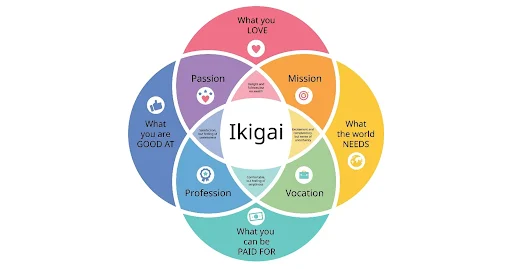
Before engaging with the science, it is worth being precise about what ikigai means — because the popular Western version of the concept has been significantly distorted in translation.
If you have encountered ikigai, you have probably seen a diagram: four overlapping circles representing what you love, what you are good at, what the world needs, and what you can be paid for. The intersection of all four is labelled ikigai — the sweet spot of a purposeful, professionally fulfilling life.
This diagram has appeared in hundreds of books, thousands of blog posts, and countless motivational presentations. It is also, according to Japanese academics who have studied ikigai for decades, largely a Western invention.
Professor Ken Mogi, a neuroscientist at the Tokyo Institute of Technology who has written extensively on ikigai, is direct about this: the four-circle framework does not originate from Japanese culture or scholarship. It appears to have been introduced by Western business writers adapting concepts from ikigai literature in ways that fitted their professional development audiences — and the simplification lost something essential.
What ikigai actually means in Japanese life — as documented by sociologists, psychologists, and cultural researchers who have studied it in its original context — is considerably more personal, more modest, and in some ways more radical than the Western version suggests.
Ikigai does not require the convergence of passion, profession, mission, and vocation. It does not need to be something grand or publicly legible. A Japanese grandmother’s ikigai might be her morning cup of matcha, the ritual of her garden, the weekly phone call with her grandchild. A retired teacher’s ikigai might be the neighbourhood walking group, the novel she is slowly reading, the houseplants she tends with daily attention.
Ikigai, in its original cultural context, is about finding what makes this life — the one you are actually living, right now, with its specific textures and relationships and daily rhythms — feel worth living. It is not a career strategy. It is a philosophy of engagement with the particular.
And this distinction, as we will see, is not merely semantic. It maps directly onto what the happiness research shows about the nature of genuine purpose.
The scientific case for the importance of purpose — having a sense that one’s life has direction, meaning, and something worth engaging with — is one of the most robust and practically important bodies of evidence in contemporary happiness research.
Viktor Frankl, the Austrian psychiatrist who survived the Nazi concentration camps and subsequently developed logotherapy, was perhaps the first clinical scientist to document the relationship between purpose and psychological survival. His central finding — that people who had a sense of meaning were more likely to survive conditions of extreme adversity — has been replicated and extended in dozens of subsequent research programmes.
The most comprehensive longitudinal evidence comes from the Harvard Study of Adult Development — the 85-year study of wellbeing discussed in multiple Rekhi Foundation blogs — which consistently finds that a sense of purpose and meaning is among the strongest predictors of both psychological and physical health over time.
But the scientific case for purpose goes considerably further than psychological wellbeing. The effects appear to be biological.
A 2014 study published in JAMA Psychiatry, led by Patrick Hill at Carleton University, tracked 6,000 adults over 14 years and found that people with a higher sense of purpose were significantly less likely to die during the study period. The effect held after controlling for age, health status, financial resources, and social connections. Having a sense of purpose was independently predictive of survival.
A 2019 study in JAMA Network Open — one of the largest of its kind, following over 70,000 older adults — found that low purpose in life was associated with significantly higher all-cause mortality and higher rates of cardiovascular disease. The magnitude of the effect was comparable to other established health risk factors including chronic disease and social isolation.
What is happening biologically? Research by Steven Cole at UCLA and Barbara Fredrickson at the University of North Carolina has documented what they call the eudaimonic effect: people who experience high levels of purpose and meaning show different patterns of gene expression than those who do not, including lower inflammatory gene expression and higher antiviral gene expression. Purpose appears to regulate the immune system at a cellular level.
The Okinawan centenarians, in other words, are not merely happy accidents of genetics and diet. They are living examples of what the research predicts: that having a reason to get up in the morning — an ikigai — is not a luxury or a philosophical refinement. It is, at a biological level, good for you in ways that medicine is only beginning to understand.
One of the most illuminating neuroscientific perspectives on ikigai connects it to a brain network that regular readers of the Rekhi Foundation blog will recognise: the Default Mode Network.
The Default Mode Network, as discussed in our blogs on flow state and the neuroscience of happiness, is the brain’s resting state system — active during mind-wandering, self-referential thought, and rumination. In the absence of engagement with something meaningful, the Default Mode Network tends toward the kinds of thinking that happiness research consistently associates with lower wellbeing: retrospective regret, prospective anxiety, social comparison, and the background hum of dissatisfaction that characterises what Csikszentmihalyi called the “psychic entropy” of unengaged consciousness.
Ikigai, understood as the presence of something that genuinely calls for engagement — something worth attending to, worth caring about, worth getting up for — counteracts psychic entropy by providing the mind with a focus that is intrinsically rather than extrinsically motivated.
This is why research on purpose consistently shows that its benefits are not merely psychological in a soft sense. They are neurological. The presence of purpose changes the default activity of the brain — providing it with what the neuroscientist Antonio Damasio calls a “background feeling of life direction” that modulates mood, attention, and motivation in ways that ramify throughout daily experience.
People with strong ikigai do not simply feel more purposeful in the moments when they engage with that purpose. They feel differently throughout the day — more grounded, more energised, more capable of absorbing difficulty without being destabilised by it. The brain that has something to engage with is, structurally, a different brain from the one that does not.
Ken Mogi, drawing on his neuroscience background and extensive research into Japanese cultural practices of ikigai, has identified five key pillars of ikigai that the research on purpose, motivation, and wellbeing directly supports. Each of these pillars illuminates something that the Western, four-circle version of ikigai misses.
The first and most distinctive pillar of authentic ikigai is its indifference to scale. Ikigai does not require a grand purpose or a professionally legible mission. It begins with small things — specific, sensory, particular things that are genuinely engaging.
This maps directly onto research by BJ Fogg at Stanford on habit formation and intrinsic motivation: the smallest genuine engagement is more powerful than the largest aspirational abstraction. A person who genuinely loves their morning ritual of preparing tea has more reliable motivational fuel than someone who has decided they are driven by a mission to change the world but has not yet found the specific, daily actions through which that mission becomes real.
It also maps onto mindfulness training research: the capacity to find genuine interest in specific, present-moment experience — the taste, the texture, the quality of light — is itself a trainable skill, and one that produces measurable improvements in wellbeing independently of any grand purpose narrative.
Ikigai begins where you are, with what is already present, and finds in it something worth attending to. This is both philosophically humbling and practically revolutionary — because it removes the common barrier to purpose that presents itself as “I haven’t found my passion yet.”
The second pillar of ikigai is self-acceptance — the practice of engaging with one’s life as it actually is, rather than as one wishes it were or as others expect it to be.
This resonates deeply with Kristin Neff’s research on self-compassion and with the extensive literature on authenticity in self-determination theory. Research consistently shows that people who approach their lives with genuine self-acceptance — who are not in constant negotiation with the gap between their actual self and their ideal self — report substantially higher wellbeing, greater resilience, and more authentic engagement with the world.
The Japanese cultural concept of wabi-sabi — the beauty of imperfection, the appreciation of the impermanent and incomplete — operates in the same space. Ikigai is not the purpose you will have when you finally achieve the right version of yourself. It is available to the flawed, incomplete, entirely specific person you already are.
The third pillar is relational: ikigai is not a purely private project. It is embedded in connection — with other people, with communities, with the natural and social world.
This aligns precisely with what happiness research consistently identifies as the single most important determinant of wellbeing: the quality of social relationships. The Harvard Study’s central finding — that close relationships are the strongest predictor of health and happiness — resonates with the ikigai literature’s emphasis on connection as constitutive of purpose rather than peripheral to it.
In Okinawan life, ikigai is embedded in what is called moai — a tight-knit social network of mutual support and shared engagement that accompanies a person throughout their life. The purpose is not experienced in isolation. It is woven into a fabric of relationships that simultaneously provide meaning and support the conditions in which meaning can be sustained.
This is the dimension of ikigai that the career-planning version most dramatically misses. Ikigai is not about finding your individual calling. It is about finding your place within a network of relationships and responsibilities — a place that is genuinely yours, that contributes to something beyond yourself, and that is held by the regard and recognition of others.
The fourth pillar is attentional: the deliberate cultivation of appreciation for the small, specific pleasures that each day contains.
This is, in effect, the ikigai version of what the happiness research literature calls savouring — the capacity to consciously attend to positive experience rather than moving through it automatically on the way to the next thing. Research by Fred Bryant at Loyola University and Timothy Wilson at the University of Virginia documents that the duration of positive emotion derived from any given experience is strongly influenced by whether the person deliberately notices and attends to it.
The Japanese aesthetic tradition — the tea ceremony, the practice of hanami (flower viewing), the deliberate appreciation of mono no aware (the pathos and beauty of transient things) — is, from a neuroscientific perspective, a sophisticated cultural technology for training the attentional system toward present-moment appreciation. It is mindfulness training as aesthetics, as ritual, as cultural practice.
The research on gratitude practice — which produces measurable and lasting improvements in wellbeing through the deliberate direction of attention toward what is good — is the scientific validation of this cultural wisdom. Small joys, deliberately noticed and appreciated, accumulate into a relationship with daily life that sustains wellbeing even through difficulty.
The fifth pillar is what the mindfulness training literature has been systematically documenting for three decades: the importance of present-moment engagement for genuine wellbeing.
Killingsworth and Gilbert’s research — finding that people are happiest when their minds are focused on what they are doing, regardless of what the activity is — is the scientific confirmation of something that ikigai, mindfulness training, and virtually every contemplative tradition across cultures has independently described.
Being in the here and now does not mean ignoring the future or forgetting the past. It means maintaining the primary orientation of attention in the living present — the place where ikigai is actually experienced, where savouring actually happens, where relationship and engagement are actually occurring.
The practice of ikigai, at its deepest level, is the practice of presence: being fully with what is actually happening, finding in it something worth engaging with, and allowing that engagement to be its own sufficient purpose.
One of the most intellectually interesting aspects of ikigai is how it converges with purpose-oriented concepts from other cultural traditions — suggesting that what it describes is not culturally specific but universally human.
The Indian concept of Dharma — living in alignment with one’s authentic nature and role — shares ikigai’s emphasis on purpose as something discovered through genuine engagement with one’s specific capacities and circumstances rather than constructed as an abstract aspiration. Both concepts locate purpose in the particular rather than the universal.
The Stoic concept of Oikeiosis — the process of recognising one’s embeddedness in a wider community and acting from that recognition — resonates with ikigai’s emphasis on connection and contribution as constitutive of purpose rather than additional to it.
Ubuntu’s “I am because we are” — the African philosophical framework examined in our earlier blog — describes the same relational structure of meaning that ikigai’s moai embodies: purpose is not privately generated but relationally constituted.
The Aristotelian concept of Eudaimonia — the highest human flourishing, achieved through virtuous activity that fully expresses one’s capacities — is perhaps the most direct Western parallel to ikigai: both locate the good life in genuine engagement rather than pleasurable feeling, in activity rather than passivity, in specific expression rather than abstract achievement.
The convergence across these traditions suggests something important: the human experience of purpose — of having something worth getting up for, of being genuinely engaged with a life that matters — may be one of the most universal of all human needs. The vocabulary differs. The cultural practices through which it is cultivated differ. But the underlying phenomenon — and its relationship to wellbeing — appears to be species-wide.
There is a paradox at the heart of the ikigai literature that connects directly to what happiness research has discovered about the direct pursuit of happiness: seeking purpose self-consciously and deliberately often undermines it.
The happiness paradox — documented by Iris Mauss and colleagues at Berkeley — shows that people who place high value on feeling happy, and who pursue happiness as an explicit goal, tend to be less happy than those who do not. The mechanism is attentional: the monitoring of one’s happiness state replaces the engaged experience that produces it.
An analogous paradox appears in the purpose literature. People who self-consciously seek their ikigai — who make finding purpose their primary project — often find that the search itself prevents the discovery. Because purpose, in its authentic form, is not found through introspection and self-analysis. It is discovered through engagement — through doing things, attending to what genuinely interests and energises you, noticing where your care is naturally drawn, and building the specific practices and relationships that sustain that engagement over time.
The Okinawan centenarians did not find their ikigai by sitting down to identify the intersection of their passions and their professional competencies. They found it by living — by continuing to engage with the specific things that called to them, the specific relationships that sustained them, the specific rhythms of daily life that felt genuinely theirs.
Viktor Frankl put it with characteristic directness: purpose cannot be pursued — it can only be detected. It is present in the pull you feel toward certain activities and relationships, in the quiet satisfaction of certain kinds of engagement, in the things that make you forget to check your phone.
The task is not to manufacture purpose but to notice it — and then to organise a life that makes space for it.
Given the science — and the important corrective that authentic ikigai provides to the simplified Western version — what does the evidence actually suggest about cultivating purpose?
Begin with attention, not analysis. The standard approach to finding purpose — asking “what am I passionate about?” or completing a values inventory — tends to produce answers that are aspirational rather than authentic. A more reliable starting point is paying attention to your actual experience: what activities produce flow states? Where does time disappear? What kinds of engagement leave you feeling energised rather than depleted? What do you find yourself thinking about when you are not required to think about anything?
Look for the small and specific, not the large and abstract. Ikigai is rarely discovered in mission statements or grand vocational narratives. It is more often found in specific, small-scale engagements that consistently produce genuine interest or satisfaction. The key word is consistently: not what you think you should care about, but what you demonstrably, repeatedly do care about.
Prioritise relationship over individual calling. Research consistently shows that purpose is most durable when it is embedded in a network of relationships and responsibilities — when it connects you to others and to something beyond yourself. The question “what is my purpose?” is often less generative than “what do I contribute to the people and communities I care about?”
Cultivate the practices that create the conditions for purpose. Mindfulness training builds the present-moment attentional capacity that makes ikigai detectable. Gratitude practice trains the attentional system toward appreciation of the specific and particular. Social investment — the deliberate maintenance and deepening of significant relationships — builds the relational context in which purpose is most naturally sustained.
Accept impermanence. The Japanese concept of mono no aware — the poignant beauty of transient things — is embedded in the ikigai tradition. Purpose is not a fixed destination but an ongoing orientation. What called to you at 30 may not be the same as what calls to you at 60. The willingness to let ikigai evolve with your life, rather than holding rigidly to its first discovered form, is part of the practice.
The Rekhi Foundation draws its work from the convergence of ancient wisdom traditions and contemporary happiness research — and the ikigai tradition offers a particularly rich opportunity for cross-cultural dialogue with the Indian philosophical inheritance.
Both traditions locate genuine wellbeing in purposeful engagement rather than passive pleasure. Both emphasise the importance of community and relationship as constitutive of meaning rather than peripheral to it. Both understand the present moment as the primary site of genuine living. Both resist the modern tendency to locate happiness in future achievement or material acquisition.
And both, in their own vocabularies and through their own practices, describe something that contemporary happiness research is confirming with increasing rigor and precision: that human flourishing is not a private achievement but a relational practice. That purpose is not something you find in yourself but something you discover through genuine engagement with others and with the world. That the life worth living is not the life that looks best from outside but the one that feels most genuinely, specifically, irreplaceably yours from inside.
The Rekhi Foundation’s Science of Happiness Course — taught across over 50 universities in 6 countries including India, the United States, Japan, the UAE, and Pakistan — brings exactly this convergence of traditions into the classroom: not as cultural comparison but as practical wisdom for building lives that genuinely flourish.
Because whether you call it ikigai, or Dharma, or eudaimonia, or human flourishing — the underlying invitation is the same.
Find what makes your life worth living. Then show up for it. Every day.
Ikigai is a Japanese concept that translates approximately as "that which makes life worth living" — the particular combination of engagement, relationship, and daily meaning that gives a life its sense of purpose and worth. It has become globally well-known primarily through a Western adaptation that presented it as a four-circle Venn diagram of passion, profession, mission, and vocation. However, as Japanese scholars including neuroscientist Ken Mogi have documented, this diagram is largely a Western invention that distorts the original concept considerably. Authentic ikigai is more personal, more modest, and more present-centred than the career-planning framework suggests — it can be found in a morning ritual, a beloved relationship, a garden, or a craft, as readily as in a professionally meaningful career. The global resonance of the concept reflects a genuine hunger for the kind of purpose and daily engagement that happiness research consistently identifies as foundational to human flourishing — and a recognition that most contemporary life structures do not adequately support it.
The scientific evidence for purpose as a health variable is both extensive and striking. A 14-year longitudinal study by Patrick Hill and Nicholas Turiano, published in Psychological Science, found that purpose in life independently predicted survival across adulthood after controlling for age, health status, and social factors. A 2019 study in JAMA Network Open tracking over 70,000 older adults found that low life purpose was associated with significantly higher all-cause mortality and cardiovascular disease rates. At the biological level, research by Steven Cole at UCLA documents that people with high levels of purpose and meaning show different patterns of gene expression — including lower inflammatory markers — than those without. The Okinawan longevity data — where having an ikigai is identified as a consistent feature of the oldest and most vital members of the community — reflects exactly what the research predicts: a reason to get up in the morning is not merely psychologically beneficial. It is, at a cellular level, protective of health.
The key differences are in scale, locus, and the role of relationship. Western concepts of purpose — particularly the "follow your passion" narrative that dominates career and self-help culture — tend to locate purpose in grand vocational narratives, individual distinctiveness, and professional achievement. They encourage the question "what is my unique calling?" and imply that purpose, once found, will be large, legible, and professionally expressed. Ikigai differs on all of these dimensions. It can be found in small, specific, daily engagements rather than grand missions. It is inherently relational — embedded in community, in the recognition and regard of others, in contribution to something beyond the self. And it is present-centred rather than achievement-oriented — found in the quality of engagement with what is already happening rather than in the anticipation of future accomplishment. Self-determination theory research supports this framing: purpose is most durable when it satisfies the needs for autonomy, competence, and relatedness simultaneously — and the relatedness dimension is what the Western calling narrative most consistently undervalues.
The most reliable path to ikigai is not introspection but observation — paying close attention to your actual experience rather than your aspirational self-narrative. Research on purpose consistently shows that people underestimate the degree to which their genuine engagements already reveal their ikigai: the activities that produce flow states, the relationships that feel most nourishing, the small daily rituals that carry disproportionate meaning, the kinds of contribution that leave you feeling genuinely satisfied rather than merely accomplished. Ken Mogi's five pillars provide a practical starting point: begin small (what specific, daily engagement genuinely calls to you?), accept yourself (what do you actually care about, rather than what you think you should care about?), connect with others (what relationships and communities feel most sustaining?), seek small joys (what specific pleasures does each day contain that you regularly fail to notice?), and be present (what would change if you were fully here, rather than rushing through?). The mindfulness training and gratitude practice elements of the Rekhi Foundation's Science of Happiness Course directly cultivate the attentional capacities — present-moment awareness, appreciation of the specific and small — that make ikigai detectable in a life that already contains it.
The Indian philosophical tradition offers several insights that both parallel and deepen the ikigai framework. The concept of Dharma — living in alignment with one's authentic nature and role, embedded within a network of relationships and responsibilities — shares ikigai's emphasis on purpose as relational and particular rather than individual and universal. The Bhagavad Gita's teaching of Nishkama Karma — acting fully in alignment with one's deepest nature without attachment to external outcomes — resonates with ikigai's freedom from the achievement orientation that characterises the Western calling narrative. The Yoga Sutras' concept of Santosha — contentment with what is present — parallels ikigai's invitation to find meaning in the particular textures of the life one is actually living. And the Indian concept of Seva — selfless service to others — reflects ikigai's emphasis on contribution and community as constitutive of purpose. The Rekhi Foundation's Science of Happiness Course draws explicitly on both traditions — understanding them not as competing frameworks but as culturally diverse expressions of the same universal insight: that human flourishing arises not from finding the perfect life, but from bringing genuine, present, caring attention to the one you already have.

Rekhi Foundation, founded in 2016, promotes Happiness Science via university centers, collaborating globally across six countries.
Table of Contents
6/79, S/F, Gurudwara Road, Karol Bagh, New Delhi – 110005, INDIA
2051, Last Chance Court, Gold River, CA 95670, USA