There is a certain irony in the fact that the country which gave the world its most sophisticated frameworks for understanding the human mind is currently experiencing one of the most significant mental health crises in its recorded history.
India is the land of the Upanishads — texts that mapped the architecture of consciousness 3,000 years before the first psychology department opened. It gave the world yoga, Ayurveda, the concept of Ahimsa, the philosophy of Dharma, and meditation practices that modern neuroscience is only now beginning to validate with fMRI machines. Its classical traditions understood the difference between fleeting pleasure and lasting wellbeing, between the satisfaction of desire and the freedom that comes from transcending it, with a precision that Western positive psychology is still working toward.
And yet.
India today ranks 118th out of 147 countries in the 2024 World Happiness Report. It has the highest rate of depression of any country in the world, according to the World Health Organisation. An estimated 56 million people in India suffer from depression, and 38 million from anxiety disorders. Suicide rates among young people — particularly students — are rising. Loneliness, despite one of the world’s densest populations, is reaching epidemic proportions in its cities.
How did the country that understood happiness most deeply come to struggle with it so profoundly?
And what can it teach the rest of the world — not just through its ancient wisdom, but through this very contradiction?
To understand what India can teach, you have to begin with what India actually said — not the popular version, stripped of its depth and sold as wellness content, but the actual philosophical tradition.

The foundational insight of the Upanishads — texts composed between 800 and 200 BCE — is one that modern happiness research has been independently approaching from its own direction for the past three decades.
Happiness is not something you acquire. It is something you already are, underneath the accumulated layers of desire, comparison, fear, and restlessness.
The Sanskrit term Ananda — usually translated as bliss — does not refer to a pleasurable sensation. It refers to the natural quality of consciousness itself when it is undisturbed. The Taittiriya Upanishad describes it as the deepest layer of the self: Anandamaya Kosha — the bliss body — which exists beneath the physical, energetic, emotional, and intellectual layers of experience.
The practical implication of this is profound: if happiness is your nature rather than a goal, then the project of wellbeing is not accumulation but clarification. Not adding more — more achievements, more possessions, more experiences — but removing what obscures what is already there.
This maps with striking precision onto what modern happiness research has established through the study of hedonic adaptation — the finding that acquiring more things, status, or experiences does not produce lasting increases in wellbeing because the baseline adjusts. Seligman’s distinction between the pleasant life (maximising positive emotions) and the meaningful life (living in alignment with deeper values and engagement) echoes the ancient Indian distinction between Bhoga (enjoyment) and Yoga (union with one’s deeper nature).
The West arrived at this conclusion through data. India arrived at it through direct contemplative inquiry, thousands of years earlier.

Patanjali’s Yoga Sutras, compiled around 400 CE, describe two practices that are directly relevant to the happiness crisis of the modern world.
Santosha — contentment — is not passive resignation. It is the active cultivation of appreciation for what is present, rather than perpetual reaching toward what is absent. It is the philosophical foundation of what modern happiness research calls gratitude practice, validated by Martin Seligman, Robert Emmons, and others as among the most reliable interventions for improving subjective wellbeing.
Aparigraha — non-grasping, non-possessiveness — is the recognition that clinging to outcomes, possessions, and identities is the primary mechanism of suffering. This maps precisely onto what contemporary psychology calls experiential avoidance and attachment to outcomes — two of the strongest predictors of anxiety, depression, and low life satisfaction in clinical research.
These were not vague spiritual aspirations. They were specific, teachable practices with detailed instruction for implementation. India had a curriculum for this. A precise, tested, millennia-old curriculum.
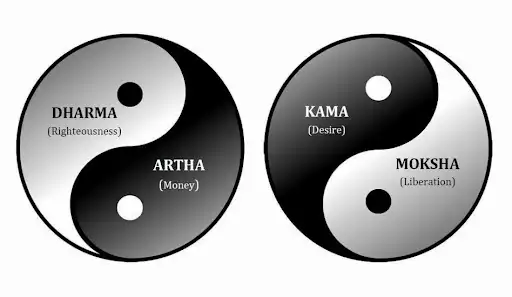
Perhaps the most comprehensive ancient Indian contribution to the science of human flourishing is the framework of the four Purusharthas — the four aims of human life.
Artha (material security and prosperity), Kama (pleasure, desire, and aesthetic experience), Dharma (ethical living, purpose, one’s authentic role in the world), and Moksha (liberation, ultimate wellbeing) — these four were understood not as competing values but as a developmental hierarchy. Artha and Kama are legitimate and necessary. But pursued without Dharma, they produce the anxiety and emptiness that contemporary research associates with purely extrinsic goal orientation. And Dharma itself, when lived fully, naturally begins to orient a person toward Moksha — the kind of deep, unconditional wellbeing that is not contingent on external circumstances.
Tim Kasser’s research at Knox College, published in The High Price of Materialism, shows that people who prioritise intrinsic goals — connection, meaning, growth — over extrinsic ones — wealth, status, appearance — consistently report substantially higher wellbeing across virtually every measure available. The Purusharthas described this hierarchy, and its consequences, approximately 2,500 years ago.
The concept of Dharma deserves particular attention because it addresses something that Western positive psychology has only recently begun to grapple with seriously.
Dharma is not simply duty or obligation. It is the alignment between an individual’s authentic nature, their capacities, their relationships, and their actions in the world. Living in accordance with one’s Dharma produces what Csikszentmihalyi calls flow — the state of deep engagement in which skills meet challenge and self-consciousness dissolves. It produces what Seligman calls Engagement and Meaning — the E and M of PERMA.
But Dharma goes further than either of these Western concepts. It situates the individual within a web of relationships — with family, community, nature, and cosmos — and understands wellbeing not as a private achievement but as an inherently relational and ecological condition.
This is the insight that modern happiness research is only beginning to catch up with. The Harvard Study of Adult Development, the longest longitudinal happiness study ever conducted, found that the quality of relationships is the single strongest predictor of wellbeing and longevity. The field of community psychology, eco-psychology, and relational neuroscience are all reaching toward a conclusion that Indian philosophy stated clearly: you cannot flourish alone. Wellbeing is not a solo project.
India also gave the world Buddhism — and with it, what may be the most precise pre-scientific account of the psychology of suffering and its resolution.
The Four Noble Truths constitute a diagnostic framework of extraordinary sophistication. The First Noble Truth — Dukkha — is not a statement that life is suffering but a precise phenomenological observation: ordinary, unexamined human experience is characterised by a pervasive sense of unsatisfactoriness, driven by the mind’s habitual patterns of craving and aversion. This maps directly onto what contemporary happiness research identifies as the negativity bias, hedonic adaptation, and the Default Mode Network — the brain’s default rumination system.
The Second Noble Truth identifies the mechanism: Tanha, or craving — the mind’s compulsive grasping after pleasure and its compulsive avoidance of discomfort. This is the basis of all addiction, anxiety, and the driven, exhausting quality of modern ambition.
The Fourth Noble Truth — the Eightfold Path — is a structured curriculum in ethical living, relational wisdom, and mental training. Samma Sati (Right Mindfulness) and Samma Samadhi (Right Concentration) are the direct ancestors of contemporary mindfulness training — now validated by thousands of peer-reviewed studies and taught in hospitals, schools, and corporations worldwide.
Buddhism did not wait for randomised controlled trials. It conducted its own trials, at scale, across 2,500 years of direct human experience. The results were consistent.
The tragedy is not simply that India ranks low on global happiness indices. It is that India possesses — in its own intellectual and cultural inheritance — almost everything that contemporary happiness research identifies as foundational to wellbeing, and it is actively losing access to it.
For most of Indian history, practices like meditation, yoga, pranayama, and Seva (selfless service) were not wellness trends or fitness activities. They were integrated into daily life — taught in families, embedded in seasonal rhythms, practised as part of religious and community life from childhood.
That integration has broken down. Urbanisation, the acceleration of work culture, the adoption of global consumption patterns, and the influence of digital technology have eroded the daily contemplative practices that formed the psychological infrastructure of Indian wellbeing.
The irony is almost painful: yoga is now more systematically practised in California than in Mumbai. Mindfulness training is being taught in Google’s offices while Indian corporations adopt hustle culture wholesale. The practices that India exported to the world are becoming less available to Indians at precisely the moment when they are most needed.
Santosha — the practice of contentment — was always going to be difficult to maintain in a world built on dissatisfaction. But India’s rapid economic growth, combined with the explosion of social media penetration in a deeply status-conscious social environment, has created conditions that are almost perfectly designed to erode it.
India now has over 800 million internet users. Social media platforms built on social comparison — Instagram, YouTube, LinkedIn — have penetrated deeply into urban and semi-urban populations, including among the young. The constant visibility of others’ curated success, wealth, and experiences has turbocharged the social comparison mechanisms that happiness research consistently identifies as among the strongest predictors of unhappiness.
The philosophical antidote — Aparigraha, the wisdom of non-grasping — is not being taught. The schools do not teach it. The families that once transmitted it have often lost their own connection to the practice. And the economic systems that now shape Indian aspiration actively reward its opposite.
India’s educational tradition was once among the most holistic in the world. The Gurukul system — whatever its limitations — understood education as the development of the whole person: ethical, intellectual, physical, and spiritual. The Nalanda and Takshashila universities were global centres not just of technical learning but of philosophical inquiry into the nature of a good life.
Contemporary Indian education is, by contrast, almost entirely oriented toward examination performance and credential acquisition. The pressure placed on Indian students — by families, by institutions, by the competitive landscape of professional entry — is among the most intense in the world. India has some of the highest rates of student suicide globally. The connection between academic pressure, mental health deterioration, and the absence of emotional wellbeing education in school and university curricula is well-documented and consistently under-addressed.
The Rekhi Foundation for Happiness has been working directly on this — bringing the Science of Happiness Course into Indian universities, including IIT Kharagpur, IIM Lucknow, Amity University, and Delhi University — precisely because the gap between what India’s educational tradition once understood and what its current educational system offers is one of the most consequential disconnections in contemporary Indian life.
One of India’s greatest historical assets in the domain of emotional wellbeing was the structure of the joint family — not as an idealised institution, but as a practical system for providing the social connection, intergenerational wisdom, belonging, and mutual care that happiness research consistently identifies as foundational to human wellbeing.
The joint family was imperfect in many ways. But it was — structurally — a wellbeing machine. Children grew up embedded in rich social networks. The elderly remained integrated into community life. Stress was distributed rather than concentrated in isolated nuclear units. Belonging was not something you had to achieve — it was simply the water you swam in.
Rapid urbanisation is dissolving this structure faster than any replacement has emerged. India’s cities are full of people who left their families for opportunity and have not yet found community. The loneliness data is beginning to reflect this: urban loneliness in India is rising sharply, particularly among young working professionals living alone in cities for the first time, with limited social infrastructure outside of work.
The philosophical tradition understood that Moksha — the highest form of wellbeing — is not achieved in isolation but through the progressive deepening of engagement with the world and with others. Yet the structures that enabled that engagement are eroding without sufficient awareness of what is being lost.
Indian philosophy and culture have historically maintained a profound relationship with nature — understood not as scenery but as the living context of human existence. The Vedic relationship with rivers, forests, and seasons as sacred was not merely ritual. It reflected an understanding that human flourishing is inseparable from ecological health and from regular contact with the natural world.
Contemporary environmental psychology research confirms what the Vedic tradition intuited: regular exposure to natural environments measurably reduces cortisol, improves attention, enhances mood, and builds the kind of restorative psychological states that buffer against stress and support wellbeing. Attention Restoration Theory and Stress Recovery Theory both document the specific neurological and physiological mechanisms through which nature contact supports mental health.
India is urbanising at a pace that makes consistent nature contact increasingly rare for the majority of its population — while simultaneously experiencing some of the world’s worst air quality, deforestation rates, and loss of urban green space. The ecological crisis and the mental health crisis are not unrelated. They share a root.
Despite — and through — this contradiction, India’s relevance to the global conversation about happiness has never been greater.
Not because ancient wisdom is inherently better than modern science. It is not. But because the convergence of India’s contemplative tradition with contemporary happiness research produces something more complete than either tradition alone — a map that combines the phenomenological depth of thousands of years of direct inquiry with the methodological rigour of empirical science.
The world is discovering, through randomised controlled trials and fMRI machines, what India described in the Upanishads, the Yoga Sutras, and the Buddhist Pali Canon. That happiness is not found in accumulation. That the quality of attention matters more than the quantity of experience. That social connection is not optional for wellbeing but biologically required. That the mind can be trained. That meaning and purpose are more reliable foundations for lasting wellbeing than pleasure. That suffering has a mechanism — and that mechanism can be understood and worked with.
These are not Indian conclusions or Western conclusions. They are human conclusions, arrived at by different methods. And India is uniquely positioned — through its cultural inheritance, its intellectual tradition, and its emerging generation of researchers, educators, and institutions — to be a leading voice in the global conversation about what it means to live well.
The Rekhi Foundation’s work — establishing Centres of Excellence for the Science of Happiness in universities across India and six countries, bridging ancient Indian wisdom with modern happiness research, and making emotional wellbeing education a structural part of higher education — is one expression of what that leadership can look like.
The happiest countries in the world — the Nordic nations that consistently top the World Happiness Report — are not happy because they have solved the philosophical question of what happiness is. They are happy because they have built social and institutional structures that consistently deliver the conditions for wellbeing: economic security, social trust, healthcare access, and meaningful community life.
India’s contribution is different and complementary. India’s gift to the world is not a policy framework. It is a depth of understanding about the inner conditions for wellbeing — the quality of attention, the relationship with desire, the role of meaning and purpose, the practice of equanimity — that no amount of institutional design can fully substitute for.
The synthesis the world needs is both: the outer structures that provide security and social connection, and the inner practices that cultivate the kind of consciousness from which lasting happiness actually arises.
India holds one half of that synthesis in its intellectual and cultural inheritance. The question — urgent, consequential, and increasingly being answered by institutions like the Rekhi Foundation — is whether India will recover, transmit, and build on that inheritance before it is lost entirely.
The answer matters not just for India. It matters for every person, in every country, who has ever sat with the quiet suspicion that the way we are living is not quite the way we were designed to live — and has wondered what a different way might look like.
India has known. It is remembering.
Kahneman, D., & Deaton, A. (2010). High Income Improves Evaluation of Life but Not Emotional Well-Being. PNAS, 107(38), 16489–16493. Nobel laureate research on the relationship between income and wellbeing, supporting the Indian philosophical distinction between material security (Artha) and deeper forms of flourishing (Dharma, Moksha) — and the limitations of purely economic approaches to happiness. → https://doi.org/10.1073/pnas.1011492107
India's low ranking on the World Happiness Report — 118th out of 147 countries in 2024 — reflects a gap between philosophical inheritance and lived social conditions. The World Happiness Report measures factors including income levels, social support, life expectancy, freedom of choice, generosity, and perceived corruption. India faces significant structural challenges in several of these areas, including economic inequality, limited social safety nets, and access to healthcare. Additionally, rapid urbanisation, the erosion of traditional community structures, intense academic and professional pressure, and the penetration of social media comparison culture have actively degraded the very conditions — connection, contentment, meaning — that India's philosophical tradition most precisely describes. India's ancient wisdom is a map. But the map has largely been disconnected from the social and educational structures that would make it practically available to ordinary people in daily life. Reconnecting that map to lived experience — through emotional wellbeing education, through programmes like the Rekhi Foundation's Science of Happiness Course — is precisely what is needed.
Indian philosophy contributes several insights to global happiness research that contemporary science is independently validating. The Upanishadic understanding that happiness is intrinsic to consciousness — not something acquired but something uncovered — maps onto modern findings about hedonic adaptation and the limitations of extrinsic goal pursuit. The Purusharthas (four aims of human life) provide a developmental hierarchy of human flourishing that anticipates self-determination theory and Seligman's PERMA model. The Buddhist analysis of craving and aversion as the mechanism of suffering prefigures cognitive-behavioural theory and Acceptance and Commitment Therapy. And the Yoga Sutras' systematic approach to mental training directly prefigures modern mindfulness training, now validated by neuroscience research from institutions including Harvard, Wisconsin, and Oxford. The world's most evidence-based happiness science and India's oldest philosophical traditions are, increasingly, describing the same reality from different angles.
Dharma — in its psychological dimension — describes the alignment between a person's authentic nature, their capacities, and their actions in the world, embedded within a network of relationships and responsibilities. This maps directly onto several central findings in happiness research: Csikszentmihalyi's flow (deep engagement when skills meet challenge), Seligman's Engagement and Meaning pillars in the PERMA model, self-determination theory's concept of autonomy in relation, and the Harvard Study's finding that relational quality is the strongest predictor of wellbeing. What Dharma adds to these Western frameworks is the explicitly relational and ecological dimension — the understanding that human flourishing is not achievable in isolation but is inherently a shared project, embedded in community, nature, and something larger than individual interest. Modern positive psychology is increasingly reaching the same conclusion through community psychology and relational neuroscience research.
The relationship is both direct and structural. India's traditional wellbeing practices — meditation, yoga, pranayama, Seva, and the contemplative dimensions of religious life — were not merely spiritual activities. They were, from a neuroscientific perspective, evidence-based practices for regulating the nervous system, building emotional resilience, cultivating mindfulness training, and maintaining social connection. Their gradual erosion — through urbanisation, the replacement of contemplative education with purely examination-focused schooling, and the adoption of consumption-oriented lifestyles — has removed the psychological infrastructure that buffered previous generations against stress, comparison, and isolation. This is not an argument for uncritical cultural conservatism. Many aspects of traditional Indian life were and are deeply unjust. But the specific practices that research now validates — meditation, gratitude, community belonging, meaning-oriented living — are precisely the ones that modernisation has most thoroughly displaced. The Rekhi Foundation's mission is to rebuild access to these practices through emotional wellbeing education in universities and institutions, grounded in both the ancient wisdom and the contemporary science.
Not only can it be — it already is, and with significant results. The Rekhi Foundation for Happiness has established Centres of Excellence for the Science of Happiness in over 50 universities across 6 countries, including leading Indian institutions such as IIT Kharagpur, IIM Lucknow, Amity University, and Delhi University. The Science of Happiness Course offered through these partnerships is credit-bearing, research-backed, and draws on both the Indian philosophical tradition and contemporary happiness research from positive psychology and neuroscience. Students who complete the course report measurable improvements in emotional regulation, life satisfaction, sense of purpose, and resilience. The Foundation's MindLab technology provides biofeedback-based measurement of physiological wellbeing indicators, bringing scientific rigour to what is ultimately an ancient inquiry. Making emotional wellbeing education a structural part of Indian higher education — not an optional elective but a foundational discipline — is both the mission and the method.

Rekhi Foundation, founded in 2016, promotes Happiness Science via university centers, collaborating globally across six countries.
Table of Contents
6/79, S/F, Gurudwara Road, Karol Bagh, New Delhi – 110005, INDIA
2051, Last Chance Court, Gold River, CA 95670, USA