Somewhere between the third and fourth minute of a guided breathing exercise on a popular wellness app, delivered in the kind of voice that suggests a person who has never experienced an urgent email, a thought tends to arrive: is this actually doing anything?
It is a reasonable question. The mindfulness app market was valued at approximately $2.08 billion in 2022 and is projected to exceed $5 billion by 2030. Calm, Headspace, Insight Timer, and a dozen competitors between them claim hundreds of millions of downloads and tens of millions of active users. The category has attracted celebrity endorsements, corporate wellness partnerships, and the enthusiastic adoption of human resources departments at companies who have found it considerably cheaper to offer employees a mindfulness subscription than to address the structural causes of workplace stress. They have also attracted the research attention of a growing number of psychologists and neuroscientists who want to know whether any of it is actually working.
The answer, characteristically for a domain this complex, is: it depends what you mean by “working,” and for whom, and compared to what. The mindfulness apps are not fraudulent. Several of them are built on genuine scientific consultation, incorporate evidence-based protocols, and produce real, measurable benefits for real people. But the research also reveals a set of significant gaps between what the apps offer and what the science of mindfulness shows actually produces durable transformation — gaps that matter especially for people who are hoping that ten minutes of daily breathing exercises will address something that the tradition from which mindfulness originates understood to be a considerably more demanding project.
This piece is an honest account of both sides.
The first and most significant thing the mindfulness app industry got right was solving a problem that the contemplative traditions never had to solve: how to make a practice that previously required a teacher, a community, a specific physical space, and a substantial investment of time and motivation accessible to someone lying on their couch at 11 p.m. with three minutes to spare before they need to sleep.
This is not a trivial achievement. One of the most consistent findings in the psychology of behaviour change is that friction — the effort required to initiate a behaviour — is among the most powerful predictors of whether that behaviour will occur. BJ Fogg at Stanford University, whose research on habit formation has influenced the design of everything from seatbelt use to vaccine uptake, has documented that even very small reductions in the friction associated with a healthy behaviour can produce large increases in adoption rates. The mindfulness apps reduced the friction of beginning a mindfulness practice to approximately zero: no teacher to find, no class to attend, no schedule to rearrange, no intimidating silence to sit in alone without guidance. This matters because, whatever their limitations, an app-based mindfulness practice is unambiguously better than no mindfulness practice at all — and for the significant proportion of their users who might not otherwise have encountered the practice at all, they represent a genuine contribution to public wellbeing.
Several of the major apps have also invested seriously in the research basis of their content. Headspace, for example, partnered with researchers at institutions including UCLA and the University of Southern California to conduct clinical trials on the effects of their specific app-based protocols. A 2018 study published in JMIR Mental Health by researchers at the University of California, San Francisco, found that Headspace produced significant reductions in stress and significant increases in compassion among healthcare workers — a population under severe and specific occupational pressure. A 2019 trial by Linardon and colleagues found that Calm reduced self-reported anxiety in users with clinically significant levels. These are not nothing. They are real effects, produced in real people, by a product that millions of people can access for the price of a monthly subscription.
The apps also introduced a generation of people — particularly younger people, and particularly people in cultures where meditation has no indigenous history — to the concept and the basic phenomenology of mindfulness: the idea that attention can be trained, that the mind’s wandering is observable, that there is a qualitative difference between being swept away by a thought and noticing it from a slight remove. These are genuinely important ideas, and the fact that they are now widely known — that “mindfulness” has become a household word across the English-speaking world and much beyond it — is, in significant part, attributable to the apps that put a basic introduction to the practice into the pockets of hundreds of millions of people.
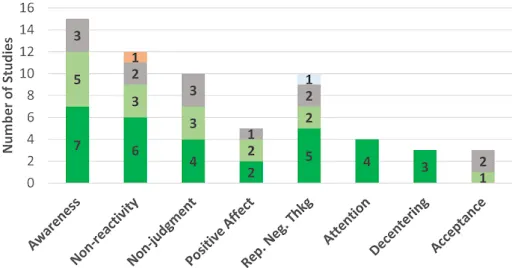
The empirical literature on app-based mindfulness is growing rapidly, and its picture is nuanced. A 2021 meta-analysis by Linardon published in Mindfulness reviewed 66 randomised controlled trials of smartphone-delivered mindfulness interventions and found significant effects on depression, anxiety, stress, and wellbeing — effects that were real but consistently smaller than those produced by in-person, instructor-led mindfulness programmes of comparable duration.
This size gap is the first significant finding. It is consistent across the literature: app-based mindfulness produces real benefits, but smaller ones than the face-to-face alternative. The reasons for this gap are the subject of active research, but several candidates have emerged. The first is the absence of a teacher — a person who can observe the practitioner’s posture, hear the quality of their questions, notice the signs of resistance or avoidance or incorrect technique, and respond in real time. The second is the absence of a community — the sangha, in the Buddhist tradition, the collective of people practising together whose shared commitment creates a social and motivational context that no algorithm has yet replicated. The third is the absence of continuity — the relationship with a teacher and community that develops across months and years, building the kind of trust and depth that allows the practice to go beyond the introductory level.
The second significant finding from the research concerns engagement and dropout. Studies of mindfulness app usage consistently find that the majority of users disengage within the first two weeks. A 2020 analysis of anonymised usage data from a large mindfulness app by Huberty and colleagues found that among users who completed at least one session, the median number of subsequent sessions was three. The distribution was highly skewed: a small number of users engaged extensively, while the majority tried the app a handful of times and stopped. This pattern is not unique to mindfulness apps — it characterises digital health interventions broadly — but it has particular significance for mindfulness practice, because the research on what mindfulness training actually requires is clear on one point above all others: consistency matters more than duration.
Amishi Jha at the University of Miami, whose research on the effects of mindfulness training on attention is among the most rigorous in the field, found in one study that even brief daily practice — as little as 12 minutes — produced significant improvements in sustained attention when maintained consistently over several weeks. But the critical word is “consistently.” The person who practises for 30 minutes on Sunday and then not again until the following weekend is, the research suggests, obtaining significantly less benefit than the person who practises for 12 minutes every day. The app model — which makes practice maximally available but provides minimal structural accountability — tends to produce the former pattern rather than the latter.
The more significant limitations of the mindfulness app model are not about duration or consistency. They are about depth — about what the tradition from which mindfulness originates understood the practice to be for, and how dramatically that understanding differs from the purposes the app industry most commonly proposes.
The word “mindfulness” in contemporary usage has been so thoroughly detached from its original context that it now functions primarily as a synonym for “stress reduction” or “relaxation” or, in its most attenuated corporate incarnation, “being present at work.” None of these descriptions is wrong, exactly. Mindfulness does reduce stress, does promote relaxation, and does improve presence. But they are descriptions of effects — side effects, almost — of a practice whose original purpose was considerably more radical.
The Pali word sati, which is translated as “mindfulness,” appears in the Satipatthana Sutta as the “direct path for the purification of beings, for the surmounting of sorrow and lamentation, for the disappearance of pain and grief, for the attainment of the true way, for the realisation of nibbana.” This is not a stress-reduction protocol. It is a path toward the complete cessation of suffering through the thorough understanding of the nature of the mind. What the mindfulness apps offer is, from the perspective of the tradition, approximately the first mile of a very long journey — and they tend to offer it without maps, without a guide who has walked the path before, and without any indication that there is more than one mile to walk.
Ronald Purser, professor of management at San Francisco State University and author of McMindfulness, has made the most sustained critique of this reduction. His argument is not that mindfulness practices are without value but that the decontextualisation of mindfulness from its ethical and soteriological framework — its extraction from the Noble Eightfold Path, from the Buddhist understanding of suffering and its causes, from the community of practitioners who provide accountability and mutual support — transforms a liberatory practice into a privatised wellness commodity. The person who uses a mindfulness app to become a calmer, more focused, more productive professional is not doing something wrong. But they are using a tool designed for liberation as a tool for optimisation — and the literature on what the practice actually produces, at depth, suggests that the two uses have different requirements and different outcomes.
Jon Kabat-Zinn, who more than anyone else is responsible for the translation of Buddhist mindfulness practices into secular Western therapeutic contexts, has consistently acknowledged this tension. His development of Mindfulness-Based Stress Reduction at the University of Massachusetts Medical School in 1979 was a deliberate and explicit secular adaptation — the extraction of specific practices from the Buddhist framework for clinical use in hospital patients with chronic pain and other conditions. MBSR was never intended, Kabat-Zinn has said, as a replacement for the full depth of the tradition. It was a door — a way in for people who might not otherwise encounter the practice at all. The mindfulness apps are, in some respects, a door to the door: an introduction to an introduction. The problem is not that doors exist. It is when people mistake the door for the destination.
The neuroscientific research on mindfulness provides perhaps the clearest illustration of the depth problem, because it makes visible the distinction between the effects of brief introductory practice and the effects of sustained, deep practice in ways that self-report measures cannot.
Richard Davidson at the University of Wisconsin-Madison, who pioneered the neuroscientific investigation of meditation’s effects on the brain, conducted the foundational research on experienced meditators — Tibetan Buddhist monks with between 10,000 and 50,000 hours of practice — and found patterns of neural activity that had not previously been documented: exceptionally high gamma-wave synchrony associated with focused attention, measurably different activation of circuits associated with positive affect and compassion, and structural differences in the prefrontal cortex, insula, and anterior cingulate cortex that reflected decades of sustained practice.
What Davidson’s more recent research has established, importantly, is a dose-response relationship between practice and neural change. Sara Lazar’s research at Massachusetts General Hospital found measurable cortical thickening after eight weeks of MBSR practice — a real and significant finding. But Davidson’s longitudinal work shows that these changes, while genuine, are qualitatively different from the neural architecture produced by decades of sustained practice. The eight-week MBSR participant and the 30-year meditating monk are, in neurological terms, at different points on the same continuum — and the distance between those points is substantial.
App-based practice, even at its most consistent, tends to produce what researchers call “state effects” — transient changes in the current state of the practitioner’s nervous system (reduced cortisol, lower heart rate, improved mood) that dissipate within hours if the practice is not sustained. “Trait effects” — lasting changes in the dispositional characteristics of the practitioner’s nervous system, the kind that show up in Davidson’s neuroimaging — require sustained, consistent, progressive practice over months and years. The research literature on app-based mindfulness has documented state effects reliably. It has not yet documented robust trait effects — and the theoretical reasons to expect it to are limited.
Judson Brewer at Brown University, whose research on the mechanisms of habit change and craving has produced some of the most practically important findings in this domain, has noted that the kind of deep curiosity about one’s own mental processes that produces robust trait effects — what he calls “getting curious” rather than merely “getting calm” — is something that the app format, with its emphasis on guidance and instruction and the reduction of discomfort, tends to discourage rather than cultivate. The practitioner who is always following an audio guide is, in some respects, not yet learning to practise. They are learning to be guided.
The Buddhist tradition identified three “jewels” as the foundation of practice: the Buddha (the teaching), the Dharma (the path), and the Sangha (the community of practitioners). Of the three, the sangha is the one that contemporary secular mindfulness has most thoroughly abandoned — and the research on behaviour change suggests this may be the most significant omission.
The social psychology of behaviour change is unambiguous: community matters. Studies of exercise behaviour, dietary change, substance use cessation, and virtually every other health behaviour examined consistently find that the social context in which a behaviour occurs is among the most powerful predictors of whether it is sustained. People who practise in groups are more consistent than people who practise alone. People who have a teacher they are accountable to are more consistent than people who are accountable only to themselves. People who practise in a community that values the practice are more consistent than people who practise in a social environment that is indifferent to it.
The app model, by design, strips the practice of its social context. This is precisely its commercial advantage — the practice can be done alone, at any time, without the friction of coordinating with other humans. But what is commercially advantageous is not necessarily what is most effective. The meditator who sits with a group twice a week, even a small group, even for 20 minutes, is embedded in a social context that provides accountability, shared motivation, and the lived experience of other practitioners at various stages of the path — which are, the tradition has always maintained, irreplaceable resources.
Research on belonging and social connection by Gregory Walton and Geoffrey Cohen at Stanford converges with the contemplative tradition’s emphasis on sangha in an unexpected but illuminating way: the experience of being part of a community that shares your values and your practice is itself a wellbeing intervention, independent of the practice’s direct effects. The mindfulness practitioner who sits with a group is receiving two benefits simultaneously — the practice itself and the belonging that the practice community provides. The app user receives one.

The Indian contemplative tradition — which produced both the mindfulness practices that the apps are based on and the broader framework within which those practices make sense — offers a considerably more complete account of what a transformative practice requires than any app currently provides.
The Yoga Sutras of Patanjali describe a progressive, eight-limbed path — Ashtanga Yoga — in which the practices of concentration (dharana), meditation (dhyana), and absorbed presence (samadhi) are embedded within a framework of ethical living (yamas and niyamas), physical preparation (asana), regulation of breath and vital energy (pranayama), and the progressive withdrawal of attention from external distraction (pratyahara). The mindfulness apps address, at most, one of these eight limbs — and even within that limb, they address only its most introductory levels.
Svadhyaya — honest self-study, the compassionate examination of one’s own patterns, reactions, and conditioning — is understood in the tradition as essential to any genuine practice, because the purpose of meditation is not the achievement of pleasant states but the understanding of the mind that produces suffering and the liberation from the patterns that maintain it. An app that guides you through pleasant breathing exercises and sends you encouraging notifications about your “streak” is not supporting Svadhyaya. It is, in some cases, actively discouraging it — because the metrics of engagement (sessions completed, minutes practised, streak maintained) create a relationship to the practice that is external and achievement-oriented rather than internal and investigative.
Santosha — contentment, the practice of finding genuine satisfaction in the present moment without the chronic reaching for something more, something different, something better — is perhaps the most radical teaching in the tradition, and the one most directly at odds with the app economy’s business model. The mindfulness app that has genuinely cultivated Santosha in its user has, in some sense, made itself unnecessary — and this is not a business model that publicly traded wellness companies are structured to pursue.
The Rekhi Foundation for Happiness, in its Science of Happiness Course offered at more than 50 universities across six countries, approaches mindfulness training from this broader framework precisely because the research — both the contemporary neuroscience and the ancient contemplative research — supports it. The course teaches mindfulness not as a stress-reduction technique to be deployed in isolated moments but as one dimension of an integrated cultivation of inner life: embedded within an understanding of what positive psychology research shows about the determinants of flourishing, supported by the community of fellow students and faculty who provide the social context that the tradition always knew was essential, and connected to the philosophical and ethical framework that gives the practice its depth and its direction.
The research, taken together, suggests a picture of what mindfulness training actually requires to produce the kind of durable, deep transformation that the Harvard Study of Adult Development and the broader happiness research literature associate with flourishing.
Consistency matters more than duration. Amishi Jha’s finding — 12 minutes daily, maintained over weeks — is more achievable than the 45-minute daily practice of the full MBSR protocol, and more realistic for most people than the hour-long sessions that many apps recommend but few users sustain. The practice that actually happens, consistently, beats the optimal practice that is repeatedly postponed.
Instructor guidance, at least periodically, matters. The research comparing app-based and instructor-led practice consistently finds larger effects in the latter, and the theoretical reasons are clear: a teacher can observe and correct what an app cannot see. This does not mean that app-based practice is valueless between instructor-led sessions — only that the app is most effectively understood as a supplement to human guidance rather than a replacement for it.
Progressive depth matters. The practitioner who has been using the same introductory breathing exercise for three years is not accumulating three years of progress. They are, in all likelihood, consolidating a comfortable habit rather than developing the cognitive and emotional capacities that deep practice produces. Moving from guided practice to unguided practice, from brief sessions to longer ones, from body-scan to open awareness — the progressive challenges that a teacher would provide — are what transform a pleasant daily habit into a genuine practice.
Community matters. Even minimal group practice — a weekly sitting with a small group, a class, a university course — provides the social context that the research on behaviour change identifies as the most powerful predictor of consistency and depth.
And the ethical and philosophical context matters — not as a prerequisite that excludes secular practitioners but as the framework that gives the practice its full meaning and direction. The practitioner who understands that mindfulness is not merely a stress-reduction tool but one dimension of the cultivation of a genuinely flourishing life — who has some framework, however provisional, for what they are cultivating and why — will engage with it differently, and more deeply, than one who is treating it as a productivity hack.
The apps are not the problem. The problem is mistaking the beginning for the end.
There is a meditation teacher who is fond of saying that talking about mindfulness is not the same as practising it, and practising it is not the same as understanding it, and understanding it is not the same as being transformed by it. The mindfulness apps occupy the first position on this spectrum — and they have made that first position available to hundreds of millions of people who might not otherwise have found it. That is a genuine contribution.
But the science of happiness, accumulated over decades of rigorous research, and the contemplative traditions, accumulated over millennia of careful first-person investigation, agree on a point that the app industry’s marketing tends to obscure: the capacity for present-moment awareness that mindfulness develops at its deepest — the capacity that produces the neural changes Davidson documented, the resilience that Jha measured, the liberation from habitual reactivity that the tradition describes — is not the product of a ten-minute daily exercise. It is the product of a sustained, progressive, community-embedded, ethically grounded practice that treats the mind as the most important and most neglected territory any human being will ever explore.
The app can begin that journey. It cannot complete it. And knowing the difference is, perhaps, the first genuinely mindful thing a practitioner can do.
The honest answer, grounded in the research, is: yes, with clear-eyed understanding of what they can and cannot provide. The meta-analytic evidence reviewed by Linardon and colleagues confirms that app-based mindfulness interventions produce real, statistically significant reductions in anxiety, depression, and stress — effects that are meaningful for the people who experience them, even if they are smaller than the effects of instructor-led programmes. For someone who has no prior experience of mindfulness practice, no access to a teacher, and limited time, an app-based practice is a genuine improvement over nothing — and "nothing" is the comparison that matters most for the majority of the apps' users. The appropriate framing is probably this: mindfulness apps are excellent at introducing the practice and providing an accessible daily structure for its early stages. They are less effective as a long-term substitute for the progressive depth, instructor guidance, and community context that the research identifies as the drivers of durable change. The most evidence-informed approach is to use the app as a starting point and a daily support while actively seeking out the instructor-led and community-based elements that the app cannot provide. Several apps — including Headspace's and Waking Up's more recent offerings — are moving in this direction by incorporating teacher-led content, group sessions, and longer structured courses that more closely approximate the MBSR model. These developments are encouraging. The goal is not to dismiss the technology but to use it appropriately — as a door that can, with the right supplementation, open onto something considerably more transformative than what the door itself contains.
Mindfulness-Based Stress Reduction, developed by Jon Kabat-Zinn at the University of Massachusetts Medical School in 1979, is an eight-week structured programme that includes 45 minutes of daily home practice, a weekly two-and-a-half-hour group session with a trained instructor, and an all-day silent retreat in the sixth week. It is the most extensively researched mindfulness intervention in the world, with a literature spanning hundreds of randomised controlled trials across populations including chronic pain patients, cancer survivors, healthcare workers, military personnel, and general community samples. The differences from app-based practice are structural rather than incidental. MBSR provides a trained instructor who has completed hundreds of hours of their own practice and specific teacher training — someone who can observe the participant's relationship to the practice and respond to it. It provides a group of eight to fifteen participants who progress through the curriculum together, providing social support, shared motivation, and the normalising experience of seeing others navigate the same difficulties. It provides a progressive curriculum that moves through body scan, seated meditation, walking meditation, yoga, and open awareness practice in a specifically sequenced way designed to build capacity incrementally. And it provides the all-day retreat — an experience of sustained, intensive practice that produces insight unavailable in ten-minute daily sessions and that participants consistently identify as among the most significant elements of the programme. The research comparing MBSR to app-based interventions consistently finds larger effects on virtually every measured outcome in the MBSR condition. This does not make the app valueless. It makes the app appropriate as an introduction or supplement, rather than a substitute.
The sangha — the community of practitioners — is not incidental to the Buddhist understanding of mindfulness practice. It is one of the Three Jewels, the three foundational supports of the entire path, alongside the Buddha's teaching and the dharma. The tradition's insistence on its centrality reflects an understanding that sustained practice in a human environment is qualitatively different from sustained practice in isolation — not just more pleasant or more motivating, but actually different in what it produces. Contemporary social psychology provides the mechanisms. Research by Gregory Walton and Geoffrey Cohen at Stanford on social belonging confirms that the felt sense of being part of a group that shares one's values and commitments is itself a source of psychological resources — increased motivation, greater resilience under difficulty, and stronger sense of identity — that is independent of the group's specific activities. Studies of exercise behaviour consistently find that group exercise adherence is significantly higher than individual exercise adherence, even when the exercise itself is identical, because the social context provides accountability, encouragement, and the shared experience of difficulty that individual practice lacks. For mindfulness specifically, the sangha provides something additional: the opportunity to observe other practitioners at different stages of the path, which gives the newer practitioner a sense of the trajectory and the longer-term practitioner a sense of the responsibility to embody what they have learned. An app provides none of this. The emotional wellbeing education in the Rekhi Foundation's Science of Happiness Course builds community explicitly into its structure — students progress through the curriculum together, discuss their practice experiences, and develop the shared vocabulary and mutual accountability that the tradition identifies as essential and the research confirms as effective.
The neuroscientific evidence is real, significant, and appropriately complex — which is to say that it neither supports the most extravagant claims sometimes made in popular media nor justifies dismissing the research as hype. Sara Lazar's foundational 2005 study found measurably greater cortical thickness in the prefrontal cortex, right anterior insula, and right sensory cortex of experienced meditators compared to non-meditators — regions associated with attention, interoception, and sensory processing. Critically, the thickness of the insula and prefrontal cortex correlated with the number of years the participants had been meditating, suggesting a dose-response relationship rather than a selection effect. Subsequent research, including Lazar's own follow-up studies, found that eight weeks of MBSR produced measurable increases in grey matter density in the hippocampus and decreases in grey matter in the amygdala — regions associated with learning and memory, and stress reactivity respectively. Richard Davidson's research with long-term practitioners found functional changes — patterns of neural activation — that are qualitatively distinct from those produced by shorter-term practice, suggesting that what the tradition describes as progressive deepening of the practice has a neural correlate. The appropriate summary is: yes, mindfulness training produces measurable changes in brain structure and function; these changes are real, replicable, and clinically meaningful; and the depth of change is proportional to the depth and duration of practice. Brief, app-based practice produces smaller and more transient changes than sustained, progressive, instructor-led practice. The "rewiring" metaphor is not wrong — but it describes a process that takes months and years, not the weeks that most app-based interventions study.
The Rekhi Foundation's approach to mindfulness training in its Science of Happiness Course reflects a conscious integration of the contemporary evidence base with the deeper framework from which mindfulness practice originates. Rather than offering mindfulness as an isolated stress-reduction technique, the course embeds it within a comprehensive understanding of what the happiness research shows about the conditions of human flourishing — so that students understand not just how to practise but why the practice matters and what, at depth, it is cultivating. Rather than teaching mindfulness through passive audio guidance, the course uses active pedagogy: students discuss their practice experiences, encounter difficulties, and develop the reflective relationship to their own mental processes that the tradition identifies as the heart of Svadhyaya — honest self-study. Rather than delivering mindfulness in isolation, the course provides the community context that the research on behaviour change and the tradition's emphasis on sangha both identify as essential: students practise together, support each other's developing practice, and build the belonging that the Harvard Study of Adult Development and Gregory Walton's belonging research show is itself a powerful determinant of wellbeing. And the course engages honestly with what mindfulness is and is not — including the distinction between the introductory practices that apps provide and the deeper practices that the tradition's full curriculum supports, so that students leave with a realistic understanding of what they are beginning and what, if they choose to continue, is available to them. This is mindfulness for students treated as the beginning of a genuine practice rather than a wellness product to be consumed and forgotten. The difference, the research suggests, is the difference between a door and a destination.

Rekhi Foundation, founded in 2016, promotes Happiness Science via university centers, collaborating globally across six countries.
Table of Contents
6/79, S/F, Gurudwara Road, Karol Bagh, New Delhi – 110005, INDIA
2051, Last Chance Court, Gold River, CA 95670, USA