There is a particular quality of experience that almost every high performer describes, across wildly different fields, in almost exactly the same language.
The surgeon who loses track of time in the operating theatre. The programmer for whom three hours pass in what felt like twenty minutes. The musician who finishes a performance and cannot clearly remember playing it. The athlete in the middle of a race who feels, simultaneously, completely effortless and completely alive. The researcher absorbed in a problem who looks up to discover it is dark outside.
They describe it as being in the zone. As flow. As the peculiar and unmistakeable feeling of doing something hard, doing it at the outer edge of your ability, and finding — to your surprise — that it feels less like effort than like release.
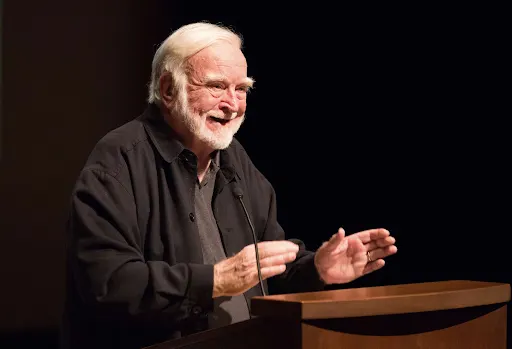
Mihaly Csikszentmihalyi, the Hungarian-American psychologist who spent fifty years studying this phenomenon, called it flow — and his account of it is one of the most important contributions to both happiness research and our understanding of human flourishing in the past century.
Not because flow is pleasant, though it usually is. But because it turns out that the conditions that produce flow are also, almost exactly, the conditions that produce the most durable and meaningful form of human happiness. And that understanding what flow is — neurologically, psychologically, experientially — tells us something essential about what peak performance and a good life have in common.
Before exploring what flow is, it is worth understanding where the research came from — because the origins are as interesting as the findings.
In the 1960s, Csikszentmihalyi began studying artists. Specifically, he was studying what happened when they worked — not the outcomes of their work, but the experience of making it. He noticed something that disrupted a basic assumption of motivation theory: the artists he studied were not primarily motivated by the finished painting. They were motivated by the act of painting itself. And when the painting was finished, many of them lost interest in it almost immediately — what had compelled them was the process, not the product.
This observation led Csikszentmihalyi to a broader investigation. What was this state? What produced it? Was it specific to artists, or was it more universal? He began interviewing rock climbers, chess players, surgeons, basketball players, musicians, and factory workers. He asked them all the same question in different ways: when do you feel most alive, most engaged, most fully yourself?
The answers, across cultures and domains and decades of subsequent research, were remarkably consistent. And they pointed not toward pleasure — not toward ease or comfort or the satisfaction of desire — but toward a very specific kind of engaged, absorbed, challenged, purposeful activity.
Csikszentmihalyi called this flow. And he argued — with a body of evidence that has only grown more robust in the decades since — that it represents one of the most important keys to human flourishing available to us.
Flow is a state of optimal experience characterised by complete absorption in a challenging activity, effortless concentration, a loss of self-consciousness, a distorted sense of time, and a deep sense of intrinsic reward — the experience of the activity as worth doing entirely for its own sake.
It is not relaxation. It is not passive enjoyment. It is not the absence of challenge. It is, in fact, the opposite of all of these things — it is the state that arises precisely at the intersection of high challenge and high skill, when what is being asked of you is at the very limit of what you can currently do.
This is one of the most important and counterintuitive insights in the entire happiness research literature: the conditions that produce the deepest satisfaction are not the conditions of ease, but the conditions of optimal difficulty.
We generally assume that happiness means comfort — that if the challenge were removed, we would feel better. But the research consistently shows the opposite. People are happiest not when life is easy but when they are fully engaged with something that stretches them. The surgeon is more satisfied in a difficult operation than a routine one. The climber is more alive on a technically demanding route than an easy trail. The student experiences more genuine satisfaction solving a hard problem than reviewing easy material.
This is not masochism. It is the discovery that the human nervous system is designed for engagement, not rest — and that the deepest experience of aliveness comes not from the absence of difficulty but from meeting difficulty with exactly the right amount of capability.
For much of Csikszentmihalyi’s career, flow was a psychological construct supported by phenomenological data — rich descriptions of the experience, but limited mechanistic understanding. In the past two decades, neuroscience has begun to fill in the biological picture, and what it reveals is remarkable.
One of the most significant neuroscientific findings about flow is what happens to the prefrontal cortex during the experience.
The prefrontal cortex — the large, distinctively human region of the brain behind the forehead — is responsible for self-monitoring, social evaluation, planning, and the running narrative we maintain about ourselves and our performance. It is, in a very real sense, the seat of the self-critic. And during flow states, its activity measurably decreases.
Researcher Arne Dietrich coined the term transient hypofrontality to describe this phenomenon: during flow, the prefrontal cortex temporarily quiets. The internal narrator — the voice that evaluates, judges, compares, second-guesses, and worries about how you are doing — becomes less active.
The practical effect is profound. Self-consciousness dissolves. The gap between intention and action closes. You are no longer performing and observing your performance simultaneously — you are simply doing. The integration that flow produces is not metaphorical. It has a neurological address.
This is also why flow states feel, paradoxically, like both effortlessness and heightened capability. The energy that would normally be consumed by self-monitoring and self-evaluation is now available to the task itself. You are not less engaged — you are more fully present because the usual fraction of your cognitive resources devoted to watching yourself has been temporarily redirected.
During flow states, the brain releases a complex cocktail of neurochemicals that contributes to the distinctive quality of the experience.
Dopamine — associated with curiosity, motivation, and the seeking of novel experience — is elevated in flow, driving the intense engagement and the appetite for continued challenge. Norepinephrine sharpens focus and heightens alertness. Anandamide — the brain’s internal cannabis compound, whose name derives from the Sanskrit word for bliss — expands lateral thinking and creative connection-making. Serotonin contributes the sense of wellbeing and social ease. Endorphins provide the sense of physical ease and pleasure.
This neurochemical combination is, according to neuroscientist Steven Kotler — who has written extensively on flow and peak performance — among the most complex and rewarding the brain produces. It explains not just why flow feels good but why it produces the quality of cognition it does: the expanded creativity, the enhanced pattern recognition, the sense of seeing connections that were previously invisible.
It also explains why flow is intrinsically motivating. The brain is, quite literally, rewarding you at a neurochemical level for being fully engaged with difficult, meaningful work. This is not an accident of evolution. It is the architecture of human flourishing — the biological signal that says: this is what you are for.
Regular readers of the Rekhi Foundation’s blog will be familiar with the Default Mode Network — the brain’s resting state system, responsible for mind-wandering, rumination, self-referential thought, and the kind of anxious, looping thinking that characterises much of modern mental life.
During flow states, the Default Mode Network is suppressed. The ruminative, self-referential activity that normally occupies a significant portion of our cognitive bandwidth is replaced by present-moment, task-focused engagement.
This is neurologically significant for the happiness research connection: Matthew Killingsworth and Daniel Gilbert’s famous 2010 study, which used a smartphone app to sample people’s experience throughout the day, found that people were happiest when their minds were focused on what they were doing — and least happy when mind-wandering, even to pleasant topics. Flow, by suppressing Default Mode Network activity, produces exactly the neurological conditions that this research identifies with subjective happiness.
You are not happier in flow because you are enjoying yourself. You are happier because you are fully present — and presence, it turns out, is the neurological substrate of happiness.
The most practically important finding in Csikszentmihalyi’s work is what determines whether flow occurs — and the answer is elegantly simple.
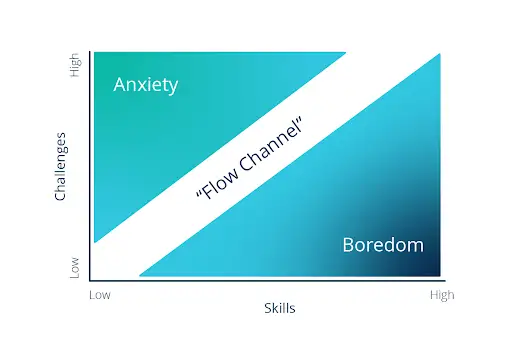
Flow arises at the intersection of challenge and skill.
When challenge significantly exceeds skill, the result is anxiety: the task feels overwhelming, the gap between what is required and what you can currently do produces threat activation, and performance and wellbeing both suffer.
When skill significantly exceeds challenge, the result is boredom: the task feels trivial, engagement withers, and the restless mind begins to wander in search of more stimulating experience.
When challenge and skill are approximately matched — when you are being asked to do something that requires the full extent of your current capability, neither crushing you nor failing to engage you — flow becomes possible.
Csikszentmihalyi called this region the flow channel: the narrow corridor of experience where difficulty and ability are calibrated to produce optimal engagement. And he made an observation that has enormous implications for how we think about both performance and education: the flow channel moves. As skill increases, the same challenge that once produced flow produces boredom. To maintain flow, challenge must scale with growing capability.
This means that human flourishing is not a static destination but a dynamic trajectory. It is not achieved and then maintained. It requires continuous calibration — the deliberate seeking of challenges that match and slightly exceed current capability. The person who stops seeking that challenge — who settles into comfortable competence, who avoids the discomfort of difficulty — does not just stagnate. They lose access to the very neurological and experiential states that make life feel most worth living.
Long before Csikszentmihalyi, philosophers were describing something remarkably similar to flow — and connecting it to exactly the concept of flourishing that happiness research has since validated empirically.
Aristotle’s concept of eudaimonia — often translated as happiness but more accurately as flourishing or “living in accordance with one’s deepest capacities” — describes a condition that is not pleasant in the hedonic sense but that constitutes the highest form of human wellbeing. It arises through virtuous activity, through the full exercise of one’s capacities in service of something meaningful.
The Greek concept of arête — excellence, virtue, the full realisation of one’s potential — is not a moral injunction but a description of a specific mode of being. The person who exercises their highest capacities in service of genuine goods is the person who flourishes. Not because it is comfortable, but because it is the fullest expression of what they are.
The Indian concept of Svadharma — living in accordance with one’s own nature and authentic role — describes the same insight from a different cultural direction. The Bhagavad Gita’s instruction to act in alignment with one’s deepest nature, without attachment to outcomes, is a description of intrinsically motivated, fully engaged action that has remarkable structural similarities to what Csikszentmihalyi documented in his interviews with artists and athletes.
The convergence is not coincidental. It suggests that flow — the optimal experience that arises when challenge meets skill in service of something meaningful — is not a modern discovery. It is a perennial human truth, independently arrived at by philosophical traditions separated by millennia and continents, and recently confirmed by neuroscience and psychology.
The Rekhi Foundation’s work — bringing the Science of Happiness into universities through the Science of Happiness Course, drawing explicitly on both ancient Indian philosophical traditions and contemporary happiness research — is built, in significant part, on exactly this convergence.
Understanding flow is interesting. Creating the conditions for it is transformative. The research identifies several conditions that consistently support or inhibit flow states.
Flow requires knowing what you are trying to do. Not a vague intention — a specific, immediate, unambiguous goal. The surgeon knows exactly what the next step of the procedure is. The chess player knows the rules and the objectives completely. The programmer knows precisely what the function needs to do.
Vague, diffuse goals do not support flow because they do not provide the attentional focus that the flow state requires. One of the most practical implications of this for daily work and study is the value of breaking large, unclear tasks into specific, immediate sub-goals — creating the conditions for engagement rather than the anxious circling that accompanies ill-defined work.
Flow requires knowing, continuously, how you are doing. The surgeon feels the tissue. The musician hears the note. The climber feels the hold. The programmer sees the code execute. This immediate feedback loop is what allows the brain to continuously calibrate and adjust — and what produces the sense of control and responsiveness that characterises flow.
Modern knowledge work often lacks this. The consequences of a decision made today may not be visible for weeks. The quality of a piece of writing may not be evaluated for months. Creating artificial feedback mechanisms — self-assessment, peer review, regular check-ins — can partially compensate for the absence of immediate natural feedback and support the conditions for engagement.
As discussed: challenge must match and slightly exceed skill. Too easy produces boredom. Too hard produces anxiety. The sweet spot is what Csikszentmihalyi called the growth edge — the point of optimal difficulty, where performance is possible but not effortless.
This has direct implications for emotional wellbeing education and learning design. The students who are most engaged are not those for whom the work is easiest, but those for whom it is appropriately difficult. The art of good teaching is in large part the art of calibrating challenge to the current capacity of the learner — and then raising the calibration as capacity grows.
Flow requires sustained, undivided attention — and this has become perhaps the most practically challenging flow condition in the modern world. The smartphone, the open-plan office, the notification architecture of modern digital life — all of these systematically fragment attention in ways that are directly incompatible with flow.
Research by Gloria Mark at the University of California, Irvine, shows that after an interruption, it takes an average of 23 minutes to return to the level of focused engagement that existed before the disruption. In a world of constant notification, most people never recover to flow-supporting concentration before the next interruption arrives.
Mindfulness training — as the Rekhi Foundation’s programmes consistently demonstrate — is one of the most effective available interventions for rebuilding attentional capacity. Not because it is the only way, but because it trains, at a neurological level, exactly the capacity that flow requires: the ability to sustain present-moment attention, notice distraction, and return to focus without being swept away.
Flow is far more accessible in activities that are pursued for their own sake than in activities pursued purely for external reward. This is one of the most consistent findings in the entire flow research literature, and it has a straightforward neurological basis: when we are intrinsically motivated — when we do something because we find it inherently engaging or meaningful — the dopaminergic reward system reinforces the activity itself. When we are extrinsically motivated — when we do something purely for external recognition or reward — the cognitive resources devoted to monitoring that external reward compete with those available for engagement with the task.
This is why the student who is genuinely curious about mathematics finds it easier to enter flow than the one who studies only to pass examinations. It is why the employee who finds meaning in their work is more productive than the one who works only for salary. And it is a direct argument for emotional wellbeing education that helps young people develop a genuine relationship with their own interests and values — because intrinsic motivation is not just psychologically healthier. It is neurologically more conducive to the peak performance that comes from flow.
The connection between flow and happiness research is not incidental. It is structural.
The PERMA model — Martin Seligman’s framework for wellbeing — places Engagement as one of its five pillars. Seligman was explicit that engagement, in the PERMA sense, is flow: the absorption in activity that produces deep satisfaction not through pleasure but through the full exercise of one’s capacities. The research on PERMA is consistent: people with high Engagement scores report substantially higher overall wellbeing than those with low scores, independently of positive emotion, relationships, or achievement.
Self-determination theory — the most comprehensive psychological account of motivation and wellbeing — identifies three core needs that must be met for genuine wellbeing: autonomy, competence, and relatedness. Flow states satisfy all three simultaneously. In flow, you are acting freely (autonomy), at the outer edge of your capability (competence), and — in collaborative flow, in performance, in service — in meaningful relationship with others or with a craft or tradition (relatedness).
The happiness research finding that people are happiest when their minds are focused on what they are doing maps directly onto the neurological characteristics of flow. The ancient philosophical traditions’ identification of engaged, purposeful activity as the highest form of human happiness converges with what Csikszentmihalyi documented. The neuroscience of transient hypofrontality and the neurochemical cascade of flow explains why this convergence occurs.
Together, they point toward a conclusion that is both empirically robust and philosophically profound: the peak of human performance and the peak of human happiness are not separate destinations. They are the same place, approached from different directions.
To flourish is to find, repeatedly and in different domains, the experience of doing something that matters, at the outer edge of what you can do, with full attention and genuine care.
That is what peak performance looks like from the inside.
And it turns out to be, at the same time, what a good life looks like.
The research on flow is not merely descriptive. It is prescriptive — it tells us, with considerable specificity, how to design work, learning, and life to increase the frequency of optimal experience.
For students: Seek the growth edge in your studies. Identify the point where material is neither effortlessly easy nor impossibly hard — and direct your attention there. Protect deep work time from digital interruption. Connect your academic work to genuine curiosity rather than purely to grades wherever possible.
For educators and universities: Design curricula that calibrate challenge to developing skill. Create feedback-rich learning environments. Reduce the fragmentation of attention through lesson design and physical environment. Teach students about flow explicitly — as the Rekhi Foundation’s Science of Happiness Course does — so they understand and can seek the conditions for their own optimal experience.
For professionals: Identify which parts of your work are in the flow channel — matched appropriately to your skill — and protect those blocks of time fiercely. Reduce meeting culture and notification interruption to create the sustained concentration that flow requires. Deliberately seek projects that stretch you to the growth edge rather than consolidating comfortable competence.
For organisations: Understand that employee wellbeing and performance are not competing interests — they are the same interest, addressed through the same conditions. Flow-supportive environments — clear goals, immediate feedback, appropriate challenge, reduced distraction, genuine autonomy — are simultaneously the environments most conducive to emotional wellbeing and to high performance.
Seligman, M.E.P. (2011). Flourish: A Visionary New Understanding of Happiness and Well-Being. Free Press. The foundational text of the PERMA model, which places Engagement — explicitly identified with flow — as one of the five core components of lasting wellbeing, establishing the formal connection between flow theory and positive psychology. → https://doi.org/10.1037/e519712014-010
Flow state, as defined by psychologist Mihaly Csikszentmihalyi, is a state of complete absorption in a challenging activity where skill and challenge are optimally matched — producing effortless concentration, loss of self-consciousness, distorted time perception, and deep intrinsic reward. Its connection to happiness research is direct and structural: research by Killingsworth and Gilbert showed that focused attention predicts subjective happiness more reliably than the activity itself, and that mind-wandering — the opposite of flow — consistently predicts lower wellbeing. Neurologically, flow suppresses the Default Mode Network (responsible for rumination and self-referential thought) and triggers a cascade of neurochemicals — dopamine, serotonin, norepinephrine, anandamide, and endorphins — that produces the distinctive quality of optimal experience. Martin Seligman's PERMA model of wellbeing explicitly identifies Engagement — flow — as one of five foundational pillars of lasting human flourishing.
Research by Csikszentmihalyi and subsequent neuroscientists identifies five primary conditions that support flow: clear, immediate goals that define precisely what success looks like in the moment; immediate feedback that continuously informs performance; an optimal challenge-skill balance — where the task is difficult enough to require full engagement but not so difficult as to produce anxiety; deep, sustained concentration free from interruption; and intrinsic motivation — genuine engagement with the activity for its own sake rather than purely for external reward. Of these, the challenge-skill balance is perhaps the most fundamental: too much challenge relative to skill produces anxiety, too little produces boredom, and flow arises in the narrow corridor between them. Mindfulness training — which builds the attentional capacity that sustained concentration requires — is among the most evidence-based preparatory practices for increasing flow access.
Yes — and the Rekhi Foundation's Science of Happiness Course addresses this directly. While flow cannot be forced, the conditions that support it can be deliberately cultivated. Emotional wellbeing education contributes to flow access in several ways: mindfulness training builds the attentional capacity that sustained concentration requires; emotional regulation skills reduce the anxiety that arises when challenge exceeds skill; values clarification helps students identify domains of genuine intrinsic motivation where flow is more readily available; and understanding the challenge-skill balance helps students calibrate their learning environments for optimal engagement rather than anxious overreach or comfortable under-challenge. The Rekhi Foundation's approach — teaching the neuroscience of peak performance alongside practices for emotional wellbeing — reflects the research finding that performance and wellbeing are not competing interests but the same interest addressed from different angles.
Flow and mindfulness training are related but distinct states, with different triggers and different neurological signatures. Mindfulness is a deliberate practice of present-moment, non-reactive awareness — typically cultivated in relatively quiet, low-challenge conditions and aimed at developing the metacognitive capacity to observe experience without being driven by it. Flow is a high-challenge, high-skill absorption state that arises during demanding activity and is characterised by the loss of self-consciousness rather than its deliberate observation. However, the two are deeply complementary: mindfulness builds the attentional infrastructure — the sustained, focused concentration capacity — that makes flow more accessible during demanding activity. Regular mindfulness training has been shown to reduce Default Mode Network activity and strengthen prefrontal attentional networks, which are precisely the neurological conditions that support flow access. Think of mindfulness as training the attentional muscle, and flow as the expression of that muscle under appropriate load.
Research on flow in educational settings points to several concrete design principles. Calibrate challenge to developing skill — not too easy (producing boredom and disengagement) and not too hard (producing anxiety and shutdown). Create feedback-rich environments where students know continuously how they are progressing, rather than relying solely on periodic examinations. Reduce attentional fragmentation — design learning spaces and session structures that protect sustained concentration rather than constantly interrupting it. Cultivate intrinsic motivation by helping students connect academic work to genuine curiosity and personal meaning rather than purely to grades and credentials. And teach students explicitly about flow — about the neurological and psychological conditions for optimal experience — so they can actively seek those conditions in their own learning. The Rekhi Foundation's Science of Happiness Course, delivered in over 50 universities across 6 countries, integrates these principles directly into its pedagogy, treating the cultivation of optimal experience as an academic subject as serious and consequential as any other.

Rekhi Foundation, founded in 2016, promotes Happiness Science via university centers, collaborating globally across six countries.
Table of Contents
6/79, S/F, Gurudwara Road, Karol Bagh, New Delhi – 110005, INDIA
2051, Last Chance Court, Gold River, CA 95670, USA