People have been asking what happiness is for as long as there have been people. The ancient Greeks debated it in marble colonnades. The Vedic sages explored it in forest retreats. Medieval philosophers argued about it in candlelit manuscripts. Poets, mystics, monarchs, and monks have all taken their turn at the question — and most of them arrived at answers that were either too abstract to be useful, too culturally specific to travel, or too dependent on circumstances that most people do not control.
What changed in the last three decades is not that we finally discovered happiness. It is that we figured out how to study it.
The science of happiness — the discipline that goes by several names in academic literature, most prominently positive psychology, subjective wellbeing research, and the neuroscience of flourishing — is the systematic, empirical investigation of what actually makes human lives go well. Not what we believe makes them go well. Not what we assume, hope, or have been told makes them go well. What the data, accumulated across decades of carefully designed research, consistently and reproducibly shows makes them go well.
The gap between those two things — what we believe produces happiness and what actually does — turns out to be substantial. It is also, once you understand it, one of the most useful pieces of knowledge a human being can possess.
Before examining what the science of happiness actually is, it is worth pausing on what it is not — because the popular culture around happiness has produced a body of assumption so thoroughly embedded that most people accept it without examination.
The dominant cultural narrative in most modern societies runs roughly as follows: happiness is the emotional reward for achievement. Get the qualifications, secure the career, reach the income level, attain the relationship, acquire the property, and happiness will follow. It is deferred, earned, and instrumental — a destination at the end of a sufficiently successful life.
This narrative is, by the evidence, demonstrably wrong.
Daniel Gilbert at Harvard University and Timothy Wilson at the University of Virginia spent decades studying what they call “affective forecasting” — our ability to predict what will make us happy in the future. Their finding, replicated across dozens of studies and hundreds of thousands of participants, is that human beings are systematically and consistently mistaken about the sources of their own future happiness. We overestimate the happiness we will derive from positive events and underestimate how quickly we will adapt back to our baseline emotional state after both positive and negative events alike. The sports car, the promotion, the house — we believe they will make us lastingly happier than they do. The redundancy, the diagnosis, the breakup — we believe they will make us lastingly more miserable than they do.
The phenomenon that Gilbert and Wilson documented — and that Ed Diener’s decades of subjective wellbeing research had independently established — is what psychologists call “hedonic adaptation”: the tendency of the human nervous system to return, relatively quickly, to a baseline level of positive affect regardless of what circumstances have changed. Lottery winners, one year after winning, report levels of life satisfaction virtually identical to those of people who had become paraplegic in accidents during the same period. This is not a quirk. It is a feature of the human nervous system — one that evolved for good reasons and that has profound implications for how we should think about the relationship between achievement and happiness.
Richard Easterlin at the University of Southern California documented what has become known as the Easterlin Paradox: within countries, richer people are on average happier than poorer people — but as countries become wealthier over time, average happiness does not rise. The United States has more than tripled its real GDP per capita since the 1960s. Its measured happiness has barely moved. The narrative that prosperity produces happiness is not supported by the data above the threshold at which basic material needs are met.
None of this means that achievement, income, and material security are irrelevant to wellbeing. They are not. Below a certain threshold — the level at which food, shelter, safety, and basic healthcare are reliably available — material conditions are strongly predictive of wellbeing. But above that threshold, the marginal contribution of additional material prosperity to subjective wellbeing diminishes sharply. The things that continue to matter, above the line of sufficiency, turn out to be qualitatively different from the things that most people are spending most of their time pursuing.
This is the first great discovery of the science of happiness: that what we are chasing is often not what will satisfy us, and that what will actually sustain our wellbeing is often precisely what we are neglecting.
The formal founding of positive psychology as an academic discipline is typically dated to 1998, when Martin Seligman delivered his presidential address to the American Psychological Association and called for a systematic science of human flourishing to complement the existing science of human pathology. Psychology, Seligman argued, had spent a century becoming extraordinarily good at understanding what goes wrong with human minds. It had not paid proportional attention to what allows them to go right.
The research programme that followed produced, over the subsequent quarter century, one of the most productive periods in the history of behavioural science. Thousands of studies. Dozens of validated measurement instruments. Multiple theoretical frameworks. And, crucially, a set of findings that have been replicated across cultures, age groups, and life circumstances with a consistency that gives them substantial credibility.
The science of happiness studies several distinct but related phenomena:
Subjective wellbeing — how people actually feel about their lives. This encompasses both cognitive evaluation (how people judge their lives when they reflect on them) and affective experience (the emotions they experience day to day). Ed Diener, who spent four decades building the scientific foundations of this field, established that subjective wellbeing is meaningfully measurable, relatively stable across time, and can be validly compared across cultures and populations.
Positive emotions — the specific emotional states that constitute the “good” side of human experience: joy, gratitude, curiosity, awe, love, enthusiasm, serenity. Barbara Fredrickson at the University of North Carolina demonstrated, in her broaden-and-build theory, that positive emotions are not merely the absence of negative ones — they have distinct neurological signatures and distinct functional consequences. Positive emotions broaden the scope of attention and thought, enabling more creative, flexible, and integrative cognitive processing. Over time, this broadened awareness builds durable personal resources: physical health, social connection, psychological resilience, and intellectual capacity. Positive emotions are, in the most literal sense, the fuel of human flourishing.
Character strengths and virtues — the stable traits that allow people to engage well with their lives and with others. Christopher Peterson and Martin Seligman’s Values in Action classification identified 24 character strengths — including curiosity, bravery, kindness, fairness, creativity, and transcendence — that appear across cultures and throughout history and that are reliably associated with wellbeing and life satisfaction when expressed in daily life.
Meaning and purpose — the sense that one’s life is oriented toward something of genuine significance. Patrick Hill at Carleton University found that purpose in life significantly predicts longevity across a 14-year follow-up, independently of health, income, and other wellbeing measures. Viktor Frankl observed, from conditions of extreme adversity, that the capacity to sustain meaning is one of the most fundamental human capacities — and one of the most protective.
Resilience — the capacity to adapt successfully in the face of adversity, trauma, tragedy, and significant sources of stress. Ann Masten at the University of Minnesota characterised resilience as “ordinary magic” — not a rare trait possessed by exceptional individuals but a common human capacity that emerges when the ordinary systems that support development — relationships, self-regulation skills, meaning frameworks — remain intact. The science of resilience has overturned the popular narrative of the lone hero who endures through sheer willpower, revealing instead a fundamentally relational and systemic capacity.
Flow and engagement — the state of optimal experience described by Mihaly Csikszentmihalyi, in which a person is so fully absorbed in a challenging activity that self-consciousness disappears, time distorts, and the activity becomes intrinsically rewarding. Flow occurs at the precise intersection of high skill and high challenge, and the research shows it is one of the richest quality-of-experience states available to human beings.
Relationships and social connection — the Harvard Study of Adult Development’s 85-year finding that relationship quality is the single strongest predictor of who flourishes in old age is perhaps the most consequential result in the entire science of happiness literature. John Cacioppo’s neuroscience of loneliness established the biological mechanisms through which social isolation produces its damaging effects: the lonely brain operates in a state of heightened threat vigilance, with elevated inflammatory markers, disrupted sleep, and suppressed immune function. Human beings are, at the deepest level of their biology, social animals — and the science of happiness has made this not merely a philosophical observation but a physiological one.

One of the most intellectually striking features of the science of happiness is that so much of what it has discovered was already known — expressed in different language, through different methods, across centuries and millennia of human contemplative and philosophical inquiry.
The Indian philosophical tradition’s concept of Ananda — bliss or deep joy — is understood not as a transient emotional state but as the inherent nature of the self, obscured by conditioning and recovered through practice. This is, in the language of contemporary psychology, a description of the hedonic baseline that the tradition understood to be the natural state of a well-cultivated mind — not a peak to be scaled but a ground to be uncovered. The science of happiness’s finding that interventions do not produce happiness so much as remove the obstacles to it is, in this light, a rigorous empirical confirmation of what the Upanishadic tradition maintained.
The Bhagavad Gita’s concept of Nishkama Karma — action without attachment to outcome — anticipates Carol Dweck’s growth mindset research by approximately 2,500 years. The psychological mechanism is the same: when the self’s identity is fused with outcomes, every failure is an existential threat. When action is performed from genuine engagement rather than outcome-dependence, the quality of both the experience and the result improves. The Gita understood the psychology; Dweck measured it.
Sthitaprajna — the person of steady wisdom described in the Gita — is not someone who feels nothing. The text is explicit on this. They experience the full range of human emotion. What they have is not the absence of feeling but the capacity to observe feeling without being enslaved by it. This is precisely the metacognitive awareness that Mindfulness-Based Cognitive Therapy — one of the most evidence-supported psychological interventions of the past 30 years — is designed to develop.
Buddhist psychology — the Abhidhamma — is among the most detailed first-person maps of mental phenomena ever produced. Its identification of lobha (craving), dosa (aversion), and moha (delusion) as the root causes of suffering maps, with remarkable precision, onto what contemporary neuroscience has documented about the threat-avoidance system and the hedonic treadmill. Sati — mindfulness, the practice of non-reactive present-moment awareness — has been studied in hundreds of randomised controlled trials and shown to produce measurable changes in brain structure and function, reduce anxiety and depression, and improve attention, immune function, and emotional regulation.
Aristotle’s eudaimonia — usually translated as happiness but more accurately understood as the full flourishing of human capacities in accordance with virtue — is the concept from which Seligman’s PERMA framework explicitly descends. The polis — the community — is, in Aristotle’s account, not the backdrop of the good life but its prerequisite: human beings flourish not despite their social nature but through it.
These convergences across traditions separated by thousands of miles and thousands of years are not coincidences. They are the evidence that both the contemplative traditions and the modern science are tracking something real — that human nature has consistent features, that these features produce consistent patterns of flourishing and suffering, and that there are practices that reliably shift people from one toward the other.
The Rekhi Foundation for Happiness was established on a conviction that the science of happiness is not merely an academic achievement. It is a practical one — with direct implications for how institutions are designed, how education is delivered, and how human beings learn to live.
The Foundation’s Science of Happiness Course, now offered at more than 90 institutions across six countries — including IIT Kharagpur, IIM Lucknow, Amity University, and 17 colleges of the University of Delhi — is the translation of this conviction into pedagogy. It is, at its core, an answer to a question that universities have been asking implicitly for centuries and explicitly avoiding: what is education ultimately for?
If the purpose of education is the transmission of information and the certification of competence in specific domains, then the existing curriculum is broadly adequate. If the purpose of education is the preparation of human beings for lives that are genuinely good — lives in which they flourish rather than merely function — then the existing curriculum has a gap at its centre.
The Science of Happiness Course fills that gap. It teaches students — through evidence-based practice, structured reflection, and community engagement — the knowledge and skills that the research most consistently identifies as the foundations of a flourishing life: the practice of gratitude and positive emotion; the cultivation of engagement and flow; the building and maintenance of genuine relationships; the development of meaning and purpose; the training of attention through mindfulness; the cultivation of self-compassion; and the understanding of what the research on resilience shows about how human beings adapt and grow through adversity.
Critically, the course integrates the Indian philosophical tradition alongside the Western positive psychology research — not as a cultural supplement but as a substantive intellectual contribution. The concepts of Dharma, Seva, Svadhyaya, and Ananda are not decorative additions to a Western curriculum. They are frameworks developed over millennia of careful first-person investigation into the nature of the mind and the conditions of human flourishing — and the science of happiness, examined carefully, is in many respects their empirical confirmation.
The course evolved at Delhi University from an Add-on course to an officially recognised Value Added Course (VAC), available across 17 colleges and the Department of Psychology. The June 2026 residential workshop in Chandigarh — “Leading DU Towards Happiness” — brought principals, the Dean of Academics Prof. Ratanbali, and faculty from across Delhi University together for three days of immersive engagement with the curriculum’s foundational ideas, followed by a meeting with the Vice Chancellor and twenty college principals to discuss the programme’s future. These are not small developments. They are the signs of an educational institution deciding that the inner life of its students is the university’s concern.
The Foundation’s MindLab technology — biofeedback devices that measure the neurological correlates of student wellbeing — brings the science of happiness into literal contact with the bodies of the students who engage with it: making visible, through real-time data, the physiological signatures of stress, attention, and calm. What the ancient traditions described in the language of consciousness and the contemporary research describes in the language of neuroscience, MindLab makes available to a student at a Delhi University college in the language of their own body.
This is what the science of happiness looks like when it is applied: not a shelf of research papers or a university lecture hall, but a living institutional commitment to the proposition that human flourishing is learnable, teachable, and worth treating as seriously as any other subject in the curriculum.
The urgency of the science of happiness is not merely academic. The global data on wellbeing is not comfortable reading. The World Happiness Report places approximately 20 per cent of the global population in countries where average life evaluation sits below 4.5 on a 10-point scale. The World Health Organisation estimates that more than one billion people currently live with a mental disorder. Depression is the leading cause of disability worldwide. Suicide claims more than 700,000 lives annually — more than malaria in many populations. Among young people between the ages of 15 and 29, it is one of the leading causes of death.
These are not personal failures distributed randomly across the population. They are the outputs of systems — educational, economic, social, cultural — that have been designed, largely without intention, to produce outcomes other than flourishing. The science of happiness is the discipline that makes visible what those systems are missing and what they could, with appropriate attention, provide.
Jean Twenge’s generational research and Jonathan Haidt’s analysis of adolescent mental health data both point to the same inflection point: the lives of young people, particularly those who have grown up in the smartphone era, show measurably deteriorating wellbeing on virtually every metric from roughly 2012 onward. The attention crisis, the loneliness epidemic, the rising rates of anxiety and depression among university students — these are not the inevitable consequences of modernity. They are the predictable consequences of environments that have been designed with insufficient attention to the conditions that the science of happiness most consistently identifies as necessary for human flourishing.
The science of happiness is the corrective — not the only one, but an essential one. It gives us the empirical basis for understanding what is missing, the evidence-based practices for addressing it, and the institutional frameworks for delivering those practices at scale.
There is a version of this answer that is theoretical — a list of findings and frameworks and validated instruments — and there is a version that is practical. The practical version is this.
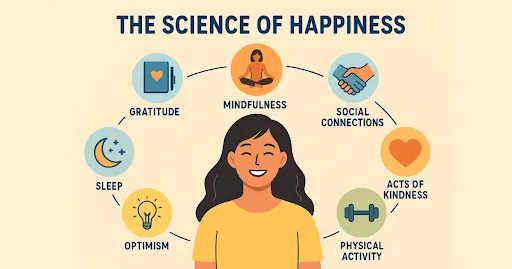
The science of happiness gives you the ability to look at your own life — your relationships, your engagement with work and activity, your emotional baseline, your sense of meaning, your capacity for self-compassion — and to understand, with some precision, what is flourishing and what needs attention. It gives you practices that have been tested against the hardest standard available: not whether they feel good in the short term, but whether they produce durable improvements in the quality of human experience over time. Gratitude practice. Mindfulness training. Acts of kindness. Investment in close relationships. The deliberate cultivation of flow. The building of meaning. The development of self-compassion.
None of these are mysterious. None of them require exceptional talent, extraordinary circumstances, or significant financial resources. They require what all genuine practices require: understanding, commitment, and time.
The science of happiness, at its most useful, is not a set of facts to be known. It is a set of capacities to be developed — an education in the art and science of living well, grounded in the most rigorous evidence available and continuous with the deepest wisdom traditions the human species has produced.
The Rekhi Foundation’s Science of Happiness Course is one model of what that education looks like in practice. But the question it is trying to answer — how does a person learn to flourish? — is not a question that belongs to any single institution or any single tradition. It is the oldest question in human experience. The science of happiness is the latest, and among the most rigorous, attempt to answer it.
The terms are closely related but not identical, and the distinction is worth understanding. Positive psychology is the academic discipline — the formal field of scientific inquiry — that Martin Seligman founded in 1998. It studies the conditions that allow individuals, communities, and institutions to flourish, using the methods of empirical psychology: controlled experiments, longitudinal studies, validated measurement instruments, and peer-reviewed publication. The science of happiness is a broader term that encompasses positive psychology but also includes contributions from adjacent fields: the neuroscience of emotion and wellbeing, subjective wellbeing research (associated most prominently with Ed Diener), the study of meaning and purpose (drawing on existential psychology and Frankl's logotherapy), and the emerging field of contemplative neuroscience (which examines the neurological effects of meditative and mindfulness practices). The science of happiness also draws on the world's contemplative traditions — particularly Indian and Buddhist philosophical psychology — as a body of first-person research on the nature of the mind and the conditions of flourishing that is complementary to, and in many cases anticipates, the findings of Western empirical science. In practice, the Rekhi Foundation's Science of Happiness Course uses the terms interchangeably, drawing on all of these streams to produce a curriculum that is both scientifically rigorous and culturally grounded. For most practical purposes, the science of happiness and positive psychology describe the same intellectual project: the systematic, evidence-based investigation of what allows human lives to go well.
This is one of the most important distinctions to make clearly, because the science of happiness is frequently associated in public perception with the self-help genre — and the association does it a disservice. Self-help is a publishing category characterised by personal testimony, motivational narrative, and the presentation of advice that may or may not have been tested against rigorous evidence. It is frequently effective at providing immediate comfort and occasionally provides genuinely useful guidance — but it is not, by design, accountable to the standards of scientific evidence. The science of happiness, by contrast, is subject to exactly the same methodological standards as any other empirical science: hypotheses must be tested in controlled conditions, findings must be replicable across independent research groups, effect sizes must be reported alongside statistical significance, and conclusions must be revised when evidence contradicts them. The field has had its share of failures to replicate and its share of findings that have not survived scrutiny — which is precisely the sign of a functioning science rather than a collection of motivated assertions. The practical difference is significant: when the science of happiness recommends a gratitude practice, it does so on the basis of Robert Emmons' replicated experimental findings, Sonja Lyubomirsky's follow-up research on the conditions under which gratitude produces its effects, and the neural correlates of gratitude that neuroscientists have identified using fMRI. When self-help recommends a gratitude practice, it typically does so on the basis of anecdotal evidence and intuitive plausibility. Both may arrive at similar recommendations; the science of happiness earns the confidence those recommendations deserve.
The objection is understandable but rests on a misunderstanding of what the science of happiness is and what it teaches. The science of happiness does not tell anyone what to feel, or prescribe a particular vision of the good life as the correct one. What it teaches is the evidence — the research on what actually produces wellbeing across populations and over time — and the practices that the evidence most consistently supports. Whether a student uses that evidence and those practices in pursuit of a creative vocation, a life of service, a spiritual path, or any other conception of the good life is entirely their own choice. The course provides the foundation; what is built on it belongs to the student. This is no different, in principle, from what any other university subject provides: the economist does not tell students what economic system to prefer; they teach the tools for understanding economic systems. The science of happiness teaches the tools for understanding and cultivating wellbeing — and then trusts students to apply them in accordance with their own deepest values. The evidence that this can be done effectively in an academic setting is now substantial: Laurie Santos's "Psychology and the Good Life" at Yale became the most popular course in that university's 300-year history. The Rekhi Foundation's Science of Happiness Course has expanded across 90+ institutions in six countries, evolving from a supplementary offering to a credit-bearing Value Added Course at Delhi University. The hunger for this education is real and documented. The question is not whether universities can teach the science of happiness, but why so many of them have taken so long to begin.
The neuroscience of happiness — the study of the neural correlates of wellbeing, positive emotion, resilience, and mindfulness — adds two things to what behavioural psychology and self-report research can provide. The first is mechanistic understanding: not just that mindfulness reduces anxiety, but how — through which neural circuits, in which brain regions, via which physiological pathways. Sara Lazar's neuroimaging research at Massachusetts General Hospital showing measurable cortical thickening after eight weeks of mindfulness practice, and Richard Davidson's work at the University of Wisconsin demonstrating lasting changes in the neural architecture of long-term meditators, provide a biological account of why these practices work that goes beyond behaviour and subjective report. The second contribution is objectivity: neurological measures — EEG patterns, fMRI activation, cortisol assays, inflammatory markers — are independent of the self-report biases and cultural expectations that can complicate psychological questionnaire data. When both self-report and neurobiological measures converge on the same finding — as they do, reliably, for mindfulness, positive emotion, and social connection — the confidence in that finding is substantially greater than either source of evidence alone provides. The Rekhi Foundation's MindLab technology brings this neuroscience dimension directly into the educational setting, using biofeedback devices to make the physiological correlates of stress, attention, and calm visible to students in real time. This is the science of happiness made literal: not as information about the brain but as lived experience of the brain's responses, available to any student willing to pay attention to what their own body is telling them.
This is the most important question the science of happiness raises, and its answer is both clear and uncomfortable. The science of happiness has produced, over the past 25 years, a detailed and well-evidenced account of what produces human flourishing. The gap between that knowledge and its implementation — in educational systems, in public policy, in institutional design, in the way organisations treat the people who work in them — is vast. The reason is not that the evidence is unavailable. It is that the incentive structures of most human institutions are not aligned with the findings of the research. Educational institutions are organised around credential production and examination performance, not around the cultivation of the inner capacities that the evidence shows most strongly predict a flourishing life. Economic systems are organised around growth metrics that have no direct connection to the subjective wellbeing of the people they affect. Social media platforms are designed to capture attention rather than to support the genuine social connection that the Harvard Study of Adult Development identifies as the most important single predictor of long-term wellbeing. The science of happiness does not suffer from a knowledge problem. It suffers from an implementation problem — and the solution to an implementation problem is not more research but more institutions willing to reorganise themselves around what the research shows. The Rekhi Foundation's expansion across 90+ universities in six countries is one example of what that reorganisation can look like. The question of whether it can happen at the scale the global wellbeing data demands is the defining challenge of the science of happiness as a practical, rather than purely academic, endeavour.
The Rekhi Foundation for Happiness works with universities, institutions, and individuals worldwide to embed the science of happiness where it matters most — at the foundations of how people learn to live. Explore the Science of Happiness Course and our programmes at rekhifoundation.com.

Rekhi Foundation, founded in 2016, promotes Happiness Science via university centers, collaborating globally across six countries.
Table of Contents
6/79, S/F, Gurudwara Road, Karol Bagh, New Delhi – 110005, INDIA
2051, Last Chance Court, Gold River, CA 95670, USA