By Bhavkaran Singh
Rekhi Center of Excellence for the Science of Happiness
For decades, happiness research has depended primarily on questionnaires.
Participants are asked how satisfied they feel with their lives, how frequently they experience positive emotions, whether they feel socially connected, and whether their lives feel meaningful. These measures remain indispensable. The problem is that they provide snapshots of experiences that are continuously changing.
A university student may complete a wellbeing survey during a relatively calm week and begin struggling during examinations, financial stress, social isolation or a family crisis shortly afterward. By the time the next survey is administered, the most important period may already have passed.
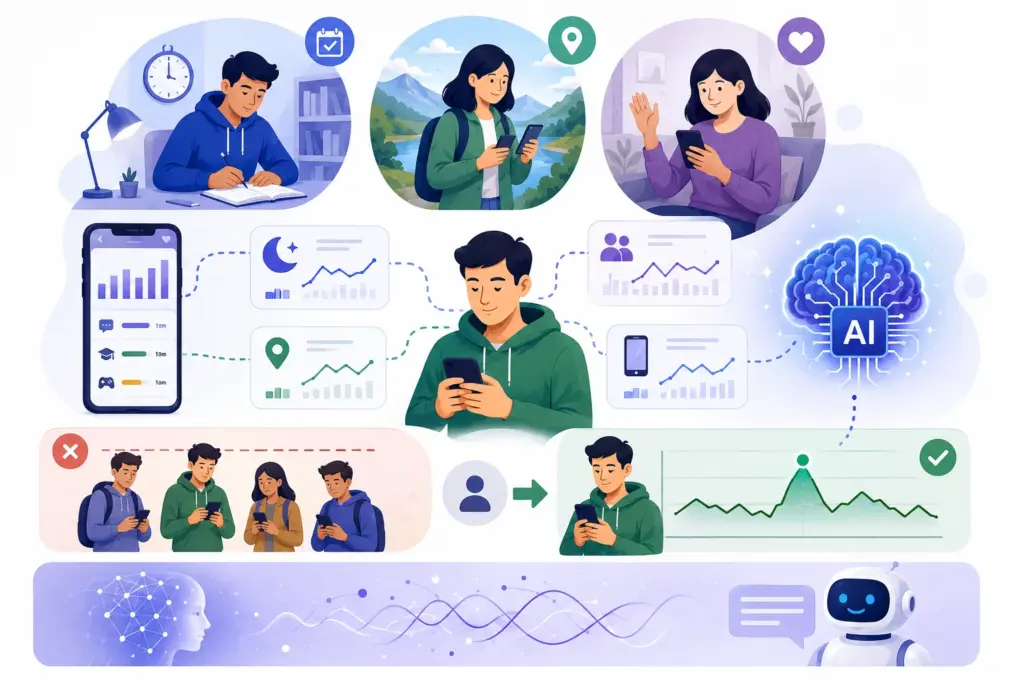
Artificial intelligence offers a possible way to narrow this measurement gap. It could help researchers understand how wellbeing changes between surveys by examining patterns in sleep, activity, routines, language, social interaction and digital behavior.
But this possibility requires an important qualification:
AI cannot directly read happiness. It can only identify patterns that may be associated with changes in wellbeing.
That distinction should guide the next generation of happiness research.
Traditional wellbeing assessments usually ask people to recall how they have felt over a period of days or weeks. Human memory, however, is influenced by recent events, current mood and particularly intense experiences.
Digital devices can provide a different kind of information.
With explicit consent, smartphones and wearable devices can capture indicators such as:
A 2025 review of 42 peer-reviewed studies found that machine learning combined with smartphone and wearable sensing could support continuous and comparatively low-burden mental-health monitoring. The same review also emphasized that sensor data are noisy, incomplete and difficult to interpret. (JMIR)
This means that digital signals should not replace self-reported wellbeing. They should complement it.
The most useful system would combine periodic validated questionnaires with behavioral information collected between assessments. Instead of producing a single “happiness score,” it would construct a wellbeing trajectory showing how an individual’s patterns change over time.
There is unlikely to be one digital pattern that represents happiness for everyone.
One student may feel best when following a highly regular routine. Another may thrive during weeks that include greater travel, social activity and variation. Increased phone use may represent isolation for one person, academic collaboration for another, and regular communication with family for someone living away from home.
Research involving 151 university students over 17 weeks found associations between smartphone-derived behavior and psychological measures. For example, greater screen activity was associated with aspects of loneliness, while time spent at significant locations was associated with depression measures. These were statistical associations, not universal psychological rules. (ScienceDirect)
This is why AI-based wellbeing research should compare people primarily with their own historical baselines.
The relevant question is not:
Does this student use their phone more than the average student?
It is:
Has this student’s behavior changed significantly from what is normal and healthy for them?
Personalized models may be better positioned to detect changes in sleep, mobility, social routines or device use that coincide with changes in self-reported wellbeing.
Recent research has explored this approach by building individualized models of routine variability. The findings suggest that personalized behavioral patterns may help people understand how changes in their routines relate to anxiety and depression. Large language models were also used to translate statistical findings into more understandable explanations. (Nature)
Some early studies demonstrate genuine promise.
A 2025 longitudinal pilot involving college students used information from smartphones, smartwatches and wearable rings to estimate depressive symptoms. The model achieved an F1 score of 0.744, with sleep quality and missed mobile interactions emerging as important predictors. However, the study included only 28 participants, and agreement between the model and the assessment measure remained moderate. (JMIR Formative Research)
This illustrates both the potential and the current limitations of the field.
AI may be able to recognize patterns associated with wellbeing changes. It cannot establish, solely from those patterns, why the change occurred. Reduced mobility could indicate depression, but it could also result from illness, examinations, remote work, weather or a preference for spending time at home.
Similarly, language models may detect emotional themes in writing, but context, humour, culture and linguistic style can change their meaning.
Therefore, an AI system should not announce:
You are unhappy.
A more responsible system might say:
Your sleep regularity and social activity have changed from your usual pattern. Your recent check-ins also indicate lower wellbeing. Would you like to reflect on what may have changed?
The second output acknowledges uncertainty, provides an explanation and leaves interpretation with the individual.
Another emerging area involves conversational AI systems that provide psychological exercises, behavioral prompts or supportive dialogue.
A 2025 systematic review and meta-analysis examined 31 randomized controlled trials involving 29,637 adolescents and young adults. AI chatbots produced small-to-moderate reductions in mental distress. However, their effects on positive affect and self-efficacy were limited, and evidence concerning generative AI systems remained inconclusive. (JMIR)
This distinction is crucial for happiness science.
Reducing depression, anxiety or stress may remove barriers to wellbeing, but happiness also involves positive psychological outcomes such as:
An AI system designed only to identify distress is not yet a happiness system.
Future research should investigate whether AI can help people actively develop these positive capacities, rather than merely respond after symptoms appear.
A credible AI-based wellbeing programme should contain five connected layers.
1. Self-Reported Wellbeing
Brief, validated questionnaires and voluntary check-ins should remain the primary source of psychological ground truth.
2. Personal Behavioral Baselines
Models should learn each participant’s typical patterns rather than judging them against a universal behavioral standard.
3. Multimodal Evidence
With separate and informed consent, research may combine sleep, activity, routine, mobility, language or interaction data. No individual signal should be treated as definitive.
4. Interpretable Insights
The system should explain which observed changes influenced an output. It should communicate uncertainty and avoid diagnostic language.
5. Human Support
AI should help individuals reflect, recommend appropriate resources and support qualified professionals. It should not replace counsellors or make autonomous clinical decisions.
Wellbeing data can become unusually sensitive because it may reveal routines, relationships, emotional states and moments of vulnerability.
Ethical safeguards therefore cannot be added after a system has already been created. They must be embedded in its architecture.
A university wellbeing platform should include:
The World Health Organization’s guidance on large multimodal models emphasizes governance, accountability and careful evaluation when AI is applied to health-related contexts. (World Health Organization)
The objective must be to increase student agency, not institutional surveillance.
The Rekhi Center’s university ecosystem creates an opportunity to study questions that individual research groups may struggle to examine:
These questions could be investigated through voluntary, longitudinal studies combining validated wellbeing assessments, carefully selected behavioral indicators and culturally adapted interventions.
The future of happiness research should not be a machine assigning every person a happiness score.
The more valuable possibility is an AI system that helps researchers observe wellbeing as a changing process, helps individuals recognize patterns in their own lives, and helps institutions evaluate whether their environments support human flourishing.
AI should not become an authority that declares whether someone is happy.
It should become a scientific instrument that helps people understand what contributes to their wellbeing, while preserving their dignity, autonomy and privacy.
That is a narrower ambition than machines that claim to understand the human mind.
It is also a far more useful one.

Rekhi Foundation, founded in 2016, promotes Happiness Science via university centers, collaborating globally across six countries.
Table of Contents
6/79, S/F, Gurudwara Road, Karol Bagh, New Delhi – 110005, INDIA
2051, Last Chance Court, Gold River, CA 95670, USA