Somewhere in the fifth century BCE, a wandering teacher sitting beneath a fig tree in what is now the Indian state of Bihar identified the restless, grasping, perpetually distracted quality of the human mind as the central problem of human existence. He called it monkey mind — kapicitta — and he spent the next forty-five years of his life describing, with unusual precision, what it does to a person and what can be done about it.
The teacher was Siddhartha Gautama. The diagnosis was attention.
Twenty-five centuries later, the founders of some of the most powerful technology companies on earth gathered engineers, behavioural economists, and neuroscientists to solve — from the other direction — exactly the same problem. Their goal was not to liberate the wandering mind but to capture it: to understand the mechanisms of attention well enough to monetise every moment of it. They succeeded. The result is what researchers now call the attention crisis — a measurable, documented deterioration in the capacity for sustained focus that is affecting millions of people across the world, and with particular severity among young people who have never known a world without the smartphone in their pocket and the infinite scroll at their fingertips.
The Buddha did not predict the iPhone. But he predicted, with remarkable fidelity, the psychological condition the iPhone would produce — and he left detailed instructions for its remedy. That those instructions, developed in the forests of ancient India, now constitute the scientific basis of one of the most evidence-supported therapeutic interventions in modern psychology is not a coincidence. It is the sign of a tradition that understood something real about the nature of the human mind.

Before examining the Buddhist prescription, it is worth being precise about the diagnosis. The attention crisis is not simply the observation that people spend a lot of time on their phones. It is a claim about a specific cognitive capacity — sustained, voluntary attention — that is declining in measurable ways, with measurable consequences for wellbeing, learning, creativity, and the quality of human experience.
Gloria Mark at the University of California, Irvine, has spent two decades measuring how people actually work. Her research, initially conducted in office environments and more recently in the era of smartphones, documents a steady contraction in the average duration of focused attention on a single task. In 2004, her team found that workers switched tasks on average every two and a half minutes. By 2012, that figure had dropped to 75 seconds. In her more recent work, she documents average focus durations as short as 47 seconds before attention migrates to something else. The significance of this is not merely productivity-related. Each switch, her research shows, costs the brain a “recovery period” — on average 23 minutes to return to full cognitive engagement with the original task — meaning that a day of frequent task-switching is, neurologically speaking, a day of almost no deep work.
Cal Newport, computer scientist and author of Deep Work and A World Without Email, argues that the capacity for sustained concentration — what he calls “deep work” — is both increasingly rare and increasingly valuable in a knowledge economy that rewards the ability to master complex information and produce creative output. The worker, the student, the researcher, the writer who can focus for two uninterrupted hours on a genuinely difficult problem has a cognitive advantage over their equally intelligent but perpetually distracted counterpart that compounds over time in ways that are difficult to overstate.
Jonathan Haidt and Jean Twenge’s research on adolescent mental health adds the wellbeing dimension to this picture. Their analysis, drawing on large-scale survey data from the United States and United Kingdom, identifies the period from roughly 2012 — when smartphone penetration among adolescents crossed a threshold — as the inflection point at which rates of anxiety, depression, loneliness, and sleep deprivation began their steep upward trajectories. The mechanisms are multiple and interacting: social media’s engineered capacity for social comparison; the displacement of face-to-face social interaction and unstructured play; the disruption of sleep architecture by late-night phone use; and the dopaminergic feedback loop — the notification, the like, the scroll — that conditions the brain to expect and require constant stimulation and makes the experience of quiet, sustained attention feel not merely boring but genuinely uncomfortable.
This last point is worth dwelling on. The attention crisis is not simply a problem of distraction. It is a problem of tolerance — or rather intolerance — for the experience of simply being present with a single thing, including with one’s own mind. When the smartphone is unavailable, many people experience not relaxation but a low-grade restlessness, a reaching for stimulation that is not there, an almost physical discomfort with stillness. The Buddha called this dukkha — a Pali word usually translated as suffering but more precisely capturing the sense of unsatisfactoriness, the persistent sense that things are not quite right, that what is present is not quite enough.
He also said it was the fundamental condition of the untrained mind.
Buddhist psychology — Abhidhamma — is, among other things, a remarkably detailed map of the mind’s movements. It identifies, classifies, and analyses mental factors with a precision that Western psychology only began to match in the twentieth century. What it has to say about attention is not incidental to the tradition. It is central to it.
The Buddha identified what he called the three poisons — akusala mula — as the root causes of suffering: lobha (craving or greed), dosa (aversion or hatred), and moha (delusion or ignorance). These three are not merely moral categories. They are, in the Buddhist psychological framework, the engines of distraction: the mind that craves is a mind that cannot rest with what is present, because it is always reaching for something else; the mind that is aversive is a mind that cannot be at peace with what is, because it is always pushing against something; the mind that is deluded is a mind that mistakes the flickering surface of experience for its deeper nature.
What the smartphone economy has achieved, with breathtaking efficiency, is the engineering of an environment that continuously activates all three. The infinite scroll activates craving — there is always something more interesting just below the fold. The outrage-optimised content feed activates aversion — the platform that makes you angry keeps you engaged. The curated highlight reel of other people’s lives activates delusion — the confusion of another person’s performance of happiness with the reality of their experience, and the corresponding confusion of one’s own authentic experience with its presumed inadequacy.
The Yoga Sutras of Patanjali — composed in a tradition closely parallel to Buddhist psychology, and equally concerned with the training of attention — describe the untrained mind’s condition as chitta vritti: the fluctuations, disturbances, or turbulence of the mental field. Patanjali’s definition of yoga — yogas chitta vritti nirodha — is usually translated as “yoga is the cessation of the fluctuations of the mind.” What Patanjali means by cessation is not the suppression of thought but the training of awareness to observe the mind’s movements without being swept away by them. The meditator is not trying to empty the mind. They are training the capacity to be with the mind as it is — including in its wandering — without identifying with every movement it makes.
This distinction is crucial, and it is one that contemporary neuroscience has confirmed. The mind wanders. This is not a failure or a pathology. It is what minds do — researchers estimate that the mind is “off-task” for somewhere between 30 and 50 per cent of waking hours, a phenomenon studied extensively by Matthew Killingsworth and Daniel Gilbert at Harvard, whose experience-sampling research found that mind-wandering predicted lower happiness regardless of what the person was doing when it occurred. The capacity that mindfulness training develops is not the elimination of mind-wandering but the quicker, gentler noticing of it — the ability to observe that the mind has drifted, and to return, without drama, without self-criticism, without the spiral of frustration about the spiral of distraction.
The Pali word sati, usually translated as mindfulness, appears throughout the Buddha’s teaching as the foundational capacity upon which all other aspects of the path depend. In the Satipatthana Sutta — one of the most important discourses in the Theravada canon, and the text most directly concerned with meditation practice — the Buddha describes sati as “the direct path for the purification of beings, for the surmounting of sorrow and lamentation, for the disappearance of pain and grief, for the attainment of the true way.”
This is not a modest claim. The Buddha is saying that the training of attention is not one practice among many but the central practice — the one that makes everything else possible.
Sati is often glossed as “bare attention” — the simple, non-reactive noticing of what is present, in the body, in the mind, in the senses, moment by moment. But the original meaning of the word is closer to “remembering” or “recollecting.” In the context of meditation, this is the capacity to remember, in this moment, what you are doing — to notice when you have been swept away by thought, sensation, or fantasy, and to return to the object of attention. This returning, practised thousands of times across thousands of meditation sessions, is not merely a meditative technique. It is the training of a cognitive capacity: the capacity to disengage from automatic, habitual patterns of reactivity and to make a conscious choice about where to direct awareness.
This is precisely the capacity that the smartphone economy erodes, and that mindfulness training restores.
The convergence between ancient Buddhist contemplative practice and contemporary neuroscience is one of the more extraordinary intellectual developments of the past three decades. It began in earnest with the collaboration between the Dalai Lama and neuroscientists — including Richard Davidson at the University of Wisconsin-Madison, whose work with long-term meditators produced findings that challenged prevailing assumptions about the brain’s capacity for change.
Davidson’s research on Tibetan Buddhist monks who had accumulated tens of thousands of hours of meditation practice found, using EEG and fMRI imaging, patterns of neural activity that had not previously been documented: exceptionally high levels of gamma-wave synchrony, associated with focused attention and heightened awareness; marked activation of circuits associated with positive affect and compassion; and measurable structural differences in regions of the brain associated with attention and emotional regulation. The monks’ brains, Davidson concluded, had been literally reshaped by decades of sustained practice.
What made these findings consequential for the broader population was the subsequent discovery, by Davidson and colleagues including Antoine Lutz, that even relatively brief periods of mindfulness training produced measurable neurological changes in people with no prior meditation experience. Sara Lazar at Massachusetts General Hospital found that eight weeks of Mindfulness-Based Stress Reduction — Jon Kabat-Zinn’s secular adaptation of Buddhist vipassana practice, developed at the University of Massachusetts Medical School in 1979 — produced measurable thickening of the prefrontal cortex and insula in participants with no prior meditation experience. These are the regions most associated with sustained attention, interoceptive awareness, and emotional regulation — exactly the capacities that the attention crisis erodes.
Judson Brewer at Brown University has taken this research in a direction with particular relevance to the attention crisis. His work on habit formation and craving demonstrates that the default mode of the addicted or compulsively distracted brain — the reach for the phone, the check of social media, the opening of another browser tab — follows precisely the lobha (craving) mechanism that the Buddha described: an automatic, unconscious reaching for stimulation or relief that bypasses conscious intention entirely. Brewer has developed mindfulness-based interventions specifically targeting craving and addiction, and his clinical research shows that mindfulness training reduces the subjective experience of craving by training the meditator to observe craving as a passing mental event rather than an imperative to be obeyed. This is, in essence, a modern neuroscientific translation of what the Buddha called upekkha — equanimity, or the capacity to observe mental events without being compelled by them.
Amishi Jha at the University of Miami has conducted research specifically on the effects of mindfulness training on attention, testing the practice in populations including military personnel and medical students — people under extreme cognitive and emotional demands. Her findings, published in Peak Mind, confirm that even brief, consistent periods of mindfulness training — as little as 12 minutes per day, maintained over several weeks — produce significant improvements in sustained attention, working memory, and the ability to resist distraction. Crucially, she found that the mere intention to meditate, without consistent practice, produced no benefit — a finding that underlines what the Buddhist tradition has always insisted: that liberation from the wandering mind is a skill, and skills require practice.
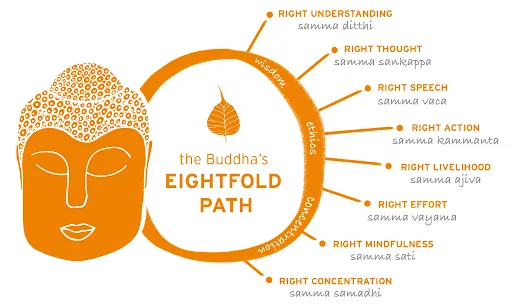
The Buddha’s prescription for the mind’s predicament was not a single technique but a complete programme, which he called the Noble Eightfold Path — Ariya Atthangika Magga. Its eight components — right understanding, right intention, right speech, right action, right livelihood, right effort, right mindfulness, and right concentration — are often presented as sequential steps but are better understood as an integrated system, each supporting and reinforcing the others.
For the purposes of the attention crisis, three of these are particularly salient.
Samma vayama — right effort — is the component most directly concerned with the relationship between intention and attention. The Buddha’s teaching on right effort involves four aspects: the effort to prevent unwholesome states from arising, to abandon those that have arisen, to cultivate wholesome states, and to maintain those that have been cultivated. This is, functionally, a programme for the deliberate management of mental attention — for choosing, with increasing consistency and skill, what the mind engages with and how. In the context of the attention crisis, right effort means the deliberate limiting of engagement with attention-fragmenting environments, not as moral self-denial but as the practical management of a cognitive resource that is finite and trainable.
Samma sati — right mindfulness — is the eighth spoke of the path and the one most directly addressed by contemporary mindfulness-based interventions. The Buddha’s elaboration of right mindfulness in the Satipatthana Sutta covers four foundations: mindfulness of the body, mindfulness of feelings (the hedonic tone — pleasant, unpleasant, or neutral — of each arising experience), mindfulness of mental states, and mindfulness of mental objects (including the hindrances to practice: desire, aversion, sloth, restlessness, and doubt). What is striking about this taxonomy is its comprehensiveness. The Buddha is not prescribing the noticing of breath only, or of the present moment in some vague sense. He is prescribing the full, attentive awareness of everything that arises in experience — sensation, feeling-tone, mental state, and the patterns that organise experience — as a moment-by-moment practice.
Samma samadhi — right concentration — points to the deeper goal toward which mindfulness practice moves: not merely the noticing of distraction but the cultivation of samadhi, a quality of collected, unified, deeply absorbed attention that is at once serene and intensely alive. This is, the Buddhist tradition maintains, the natural state of the well-trained mind — not the agitated, fragmented condition of the distracted mind, but not the blank emptiness of mental suppression either. It is the condition that Csikszentmihalyi described, from a secular psychological perspective, as flow: total absorption, effortless engagement, the disappearance of self-consciousness, the experience of time passing without being noticed.
The research on the attention crisis has particular urgency when it concerns young people, whose attentional capacities are still developing and who are simultaneously among the most heavily exposed to attention-fragmenting technology.
Mary Helen Immordino-Yang at the University of Southern California’s Brain and Creativity Institute has documented what she calls the “default mode network” — the brain regions associated with self-referential thinking, social cognition, moral reasoning, and the construction of personal narrative — and found that these regions are active primarily during periods of rest and inward-directed attention: the very conditions that the smartphone eliminates most thoroughly. Her research suggests that chronic overstimulation — the filling of every moment with external input — impairs not merely concentration but the deeper cognitive functions associated with the development of identity, empathy, and moral sophistication. The adolescent who never experiences boredom — who fills every pause with a screen — is not merely distracted. They are being deprived of the internal mental space in which the most important developmental work of adolescence takes place.
Peter Gray’s research on the decline of free, unstructured play converges with Immordino-Yang’s findings from a different angle: the disappearance from childhood and adolescence of the conditions under which self-directed, intrinsically motivated engagement — the kind that naturally produces flow — was previously the norm rather than the exception. The child who played outdoors for hours, absorbed in games of their own invention, was not merely having fun. They were training attention, building emotional regulation, developing the capacity for sustained engagement that the structured, screen-mediated, adult-directed environments of contemporary childhood systematically fail to cultivate.
The Rekhi Foundation for Happiness addresses this directly in its Science of Happiness Course, offered at more than 50 universities across six countries. Mindfulness training is embedded in the curriculum not as a wellness supplement but as a foundational cognitive and emotional skill — the trained capacity for present-moment awareness that the happiness research consistently identifies as among the most powerful contributors to sustained wellbeing, academic performance, and relational quality. The students who complete the course are not learning to sit in silence for its own sake. They are developing the attentional architecture upon which everything else — learning, creativity, connection, and the experience of a life that is genuinely and fully lived — depends.
The Buddha’s prescription, stripped of its doctrinal elaboration and translated into the terms of contemporary cognitive science, reduces to a handful of practices that the research has now validated with considerable rigour.
The first is formal meditation practice — the daily, consistent commitment of a period of time to the deliberate training of attention. This need not be long: Amishi Jha’s research suggests that 12 minutes of daily mindfulness practice, maintained consistently, produces measurable improvements in attentional capacity. Jon Kabat-Zinn’s 8-week MBSR protocol, the most extensively studied mindfulness intervention in the world, involves 45 minutes of daily practice along with a weekly group session — and has accumulated a research literature demonstrating significant reductions in anxiety, depression, and stress, along with improvements in attention, immune function, and subjective wellbeing, across thousands of participants in dozens of countries.
The second is informal practice — the extension of mindful awareness into the ordinary activities of daily life. This is what the Buddhist tradition calls sati in action: the full, attentive presence with whatever one is doing, whether eating, walking, listening, or speaking. In the context of the attention crisis, this means the deliberate choice to do one thing at a time — to eat without scrolling, to walk without earphones, to have a conversation without the phone on the table. These are not deprivations. They are, the research suggests, the conditions under which the activities of daily life become sources of genuine pleasure and satisfaction rather than the background noise against which we wait for something more interesting.
The third is what the tradition calls sila — ethical conduct — and what the contemporary research might call the management of attentional environment. The Buddha understood that the training of attention is not merely an inner project: the quality of the environment in which one lives and works shapes the ease or difficulty of the practice. For the contemporary practitioner, this means the deliberate structuring of the attentional environment — the placement of the phone in another room during work and sleep, the turning off of notifications, the protection of morning and evening from the demands of the device — not as moral performance but as the practical engineering of the conditions in which sustained attention is possible.
Metta — loving-kindness practice — deserves particular mention in the context of the attention crisis because of what it trains beyond attention itself. Metta involves the deliberate cultivation of warm goodwill toward oneself, toward loved ones, toward neutral persons, toward difficult persons, and ultimately toward all beings. Research by Barbara Fredrickson at the University of North Carolina, who has studied loving-kindness meditation more extensively than perhaps any other Western researcher, found that a seven-week loving-kindness training produced significant increases in daily positive emotions, which in turn produced increases in personal resources — mindfulness, purpose, social support, and reduced illness symptoms — that persisted after the practice period ended. The Buddhist tradition understood this as the natural consequence of what Fredrickson’s broaden-and-build theory describes: positive emotions broaden awareness and build psychological resources over time.
There is a teaching in the Buddhist tradition that cuts to the heart of why distraction is so seductive and so difficult to resist, and why the prescription for it is ultimately not about willpower but about understanding.
Anicca — impermanence — is one of the three marks of existence in Buddhist thought. Everything that arises passes. No sensation, no thought, no emotional state, no experience of any kind is permanent. This is not merely a philosophical observation. It is a description of the moment-by-moment nature of experience as it actually is — the ceaseless arising and passing of events in consciousness that the meditator learns to observe directly in practice.
The relevance to distraction is this: the craving mind is a mind that does not want to be with impermanence. It wants to hold onto what is pleasant, to escape what is unpleasant, and to be free from the uncertainty of not knowing what comes next. The smartphone, with its capacity to provide a constant supply of novel stimulation — a new notification, a new story, a new outrage, a new affirmation — is the perfect prosthesis for a mind that cannot tolerate impermanence. It provides the illusion of constant engagement, constant significance, constant connection: the opposite of having to sit with the passing of one moment and the uncertain arrival of the next.
Mindfulness training, in the Buddhist framework, is ultimately the training of the capacity to be with anicca — to let experience be as it is, arising and passing without needing to grasp it or escape it. What meditators report, and what the research confirms, is that this capacity — once developed even partially — changes the relationship to distraction fundamentally. The notification does not lose its pull overnight. But the practitioner begins to experience a gap — sometimes very brief, sometimes broader — between the impulse and the action. In that gap is the possibility of choice. And in the accumulation of those choices, practised day after day, the mind gradually becomes more its own master and less the product of whoever most effectively engineered its attention.
The Buddha’s contribution to the attention crisis is not the smartphone. But it is, in an important sense, older and more fundamental than any technology — because it is a description of the mind itself, of what it does when left untrained, and of what becomes possible when it is patiently, compassionately, consistently brought to attention.
The attention crisis is real. Its consequences — for learning, for wellbeing, for the quality of human relationships and human experience — are measurable and significant. And the research-backed remedy turns out to be, at its core, the same one that a wandering teacher in fifth-century Bihar arrived at beneath a fig tree: the radical, demanding, quietly revolutionary act of paying attention to what is actually happening, right now, with kindness and without judgement.
It is among the oldest prescriptions in human history. It has never been more urgently needed.
The evidence is substantial and specific enough to distinguish mindfulness training from relaxation. Amishi Jha and colleagues at the University of Miami have conducted some of the most rigorous research on this question, using objective attention tasks — not self-report — to measure the effects of mindfulness training on attentional capacity. Their studies with highly stressed populations, including military personnel and medical students, found that 12 minutes of daily mindfulness practice, maintained over several weeks, produced significant improvements on objective measures of sustained attention and working memory — the capacity to hold information in mind while processing something else. These are not relaxation effects. They are specific cognitive improvements consistent with the training of a particular neural capacity. Sara Lazar's neuroimaging research at Massachusetts General Hospital found measurable structural changes in the prefrontal cortex and insula — regions associated with sustained attention and interoception — after just eight weeks of MBSR practice in participants with no prior meditation experience. Richard Davidson's work at the University of Wisconsin with long-term practitioners found even more pronounced neural differences, including patterns of gamma-wave activity associated with heightened attentional focus that had not previously been documented in non-meditating populations. The convergence across methods — behavioural tasks, self-report, neuroimaging, and EEG — on consistent findings about the attention-enhancing effects of mindfulness training is among the strongest features of this research literature. The practice is not relaxation. It is, as the Buddhist tradition always maintained and as the science now confirms, a form of cognitive training with specific and measurable outcomes for the capacity that the attention crisis most directly erodes.
The difference is significant and worth being precise about. Sati in the Buddhist tradition is not a stress-management technique or a productivity tool. It is the first step on a path whose ultimate aim is liberation — nibbana — the complete cessation of suffering through the thorough understanding of the mind's nature. The ethical and philosophical framework within which sati is embedded — the Noble Eightfold Path, with its commitments to right speech, right action, and right livelihood — is integral to the tradition's understanding of what mindfulness practice is for and what it can produce. The secular mindfulness that has proliferated in corporate wellness programmes, schools, and smartphone apps since the 1990s is a deliberate extraction of the attentional training techniques from this broader framework — what scholars including Ronald Purser, author of McMindfulness, have critiqued as the reduction of a transformative tradition to an individual productivity intervention that leaves structural causes of stress unexamined and unchallenged. This is a legitimate critique. Jon Kabat-Zinn, who more than anyone else is responsible for the secular adaptation of Buddhist mindfulness practice, has acknowledged it: MBSR was designed as a clinical intervention for specific populations, not as a replacement for the full depth of the tradition. For those who come to mindfulness through its secular, evidence-based applications, the Buddhist tradition offers a far richer context — a complete psychological and philosophical framework within which the training of attention is understood as one dimension of a comprehensive programme for human flourishing. The Rekhi Foundation's mindfulness for students curriculum attempts to preserve this depth: the practices are evidence-based and accessible, but they are taught in connection with a broader understanding of what emotional wellbeing and human flourishing actually require.
The connection is more direct than it might initially appear. The attention crisis, at its psychological root, is a crisis of tolerance for impermanence. The smartphone's infinite scroll provides something that the untrained mind craves: the elimination of the experience of waiting, of not knowing what comes next, of the moment-by-moment uncertainty that is simply the texture of conscious experience when you are not filling it with external stimulation. Every pull-to-refresh is, neurologically, a tiny resolution of uncertainty — a brief relief from the anxiety of not knowing. What the Buddhist tradition understood, and what Judson Brewer's neuroscientific research on craving has now confirmed, is that this relief is never more than temporary. The craving mind is not satisfied by stimulation; it is amplified by it. Each relief produces a slightly lower threshold for the discomfort that triggers the next reach for the phone. This is the mechanism of addiction, and it operates on precisely the same dopaminergic pathways regardless of whether the substance is alcohol, nicotine, or social media. Anicca offers a different relationship to this experience. When the meditator has practised observing the arising and passing of experience — when they have sat with the discomfort of restlessness and watched it change, with the pleasure of absorption and watched it pass, with the boredom of a quiet moment and observed that boredom, too, is impermanent — they develop what the tradition calls vipassana: insight into the actual nature of experience. From this insight, the compulsive reaching for external stimulation begins to lose its grip — not through suppression but through understanding. The emotional wellbeing that results is not the pleasure of constant stimulation but the deeper satisfaction of a mind that is genuinely at home in the present moment.
The Buddhist tradition has always understood that formal meditation practice — the deliberate, structured period of sitting with attention — and informal practice — the extension of mindful awareness into daily activities — are both essential and mutually supporting. For students and young people navigating demanding academic and social environments, the informal practices are often the more immediately accessible entry point. The most fundamental informal practice is the choice to do one thing at a time. Eating a meal without a screen. Walking between classes without earphones. Having a conversation with a friend without the phone on the table. These are not merely courtesy gestures — they are attentional practices with measurable effects on the quality of the experience and on the strengthening of the neural pathways associated with sustained, voluntary attention. A second informal practice that the tradition specifically recommends for students is mindful study — the deliberate setting of a specific period of uninterrupted engagement with material, followed by a genuine break, rather than the continuous partial attention that characterises most contemporary studying. Gloria Mark's research shows that the brain needs recovery time after distraction; structuring study in focused blocks — what Cal Newport calls "deep work sessions" — is the practical translation of samma samadhi (right concentration) into academic life. A third practice, accessible to everyone and requiring no special setting or equipment, is what the tradition calls anapanasati — mindfulness of breathing. Three deliberate, attentive breaths before opening a social media app, before responding to a provocative message, before beginning a study session: this is not meditation in the full sense, but it is the same faculty — the returning of attention to a chosen object — practised in the ordinary moments of daily life. And it is this faculty, practised persistently in small moments, that the research shows accumulates into the larger capacity for sustained attention that the science of happiness identifies as central to human flourishing.
The connection is foundational rather than supplementary. The science of happiness — as synthesised in frameworks like Seligman's PERMA model and as documented across decades of research in positive psychology — consistently identifies present-moment awareness and engagement as among the most powerful contributors to subjective wellbeing. Matthew Killingsworth and Daniel Gilbert's experience-sampling research, cited widely in the happiness research literature, found that mind-wandering predicted lower happiness regardless of activity — and that people were happiest when they were fully present in whatever they were doing, including activities that were not inherently pleasurable. This finding is a direct empirical confirmation of what the Buddhist tradition has maintained for 2,500 years: that the quality of attention determines, to a very large degree, the quality of experience. Mindfulness training, as the mechanism for developing that quality of attention, is therefore not a peripheral practice in the science of happiness but a central one. Barbara Fredrickson's loving-kindness research demonstrates that the cultivation of positive emotional states through meditative practice produces durable increases in personal resources and wellbeing that persist beyond the practice period — consistent with the Buddhist understanding that the training of the mind has cumulative effects that extend far beyond the meditation cushion. The Rekhi Foundation for Happiness builds mindfulness training into the Science of Happiness Course precisely because the evidence — both the 2,500-year-old evidence of the contemplative tradition and the contemporary evidence of cognitive neuroscience and positive psychology — converges on the same conclusion: that the capacity to pay attention is not a gift distributed unevenly at birth but a trainable skill, and that its cultivation is among the most important investments a young person, or any person, can make in their own flourishing.

Rekhi Foundation, founded in 2016, promotes Happiness Science via university centers, collaborating globally across six countries.
Table of Contents
6/79, S/F, Gurudwara Road, Karol Bagh, New Delhi – 110005, INDIA
2051, Last Chance Court, Gold River, CA 95670, USA